Why Your Website Gets Traffic but No Leads: 12 Reasons & How to Fix Them in 2026
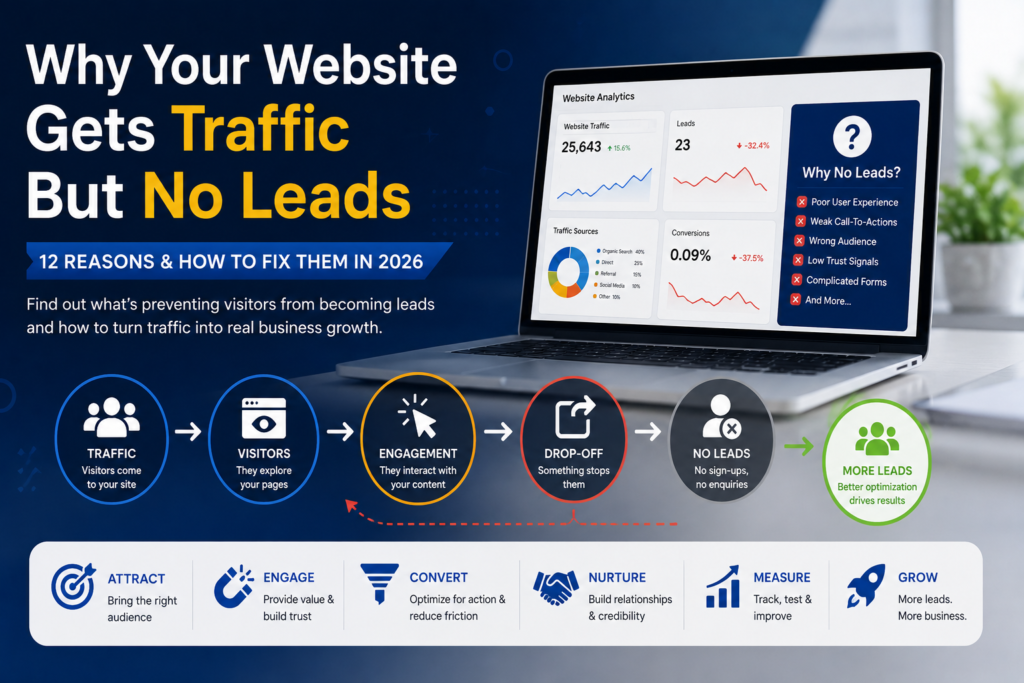
Getting website traffic is a great start, but traffic alone doesn’t grow a business.
You may have hundreds, thousands, or even tens of thousands of visitors coming to your website every month, yet your contact forms remain empty, phone calls are limited, and sales opportunities are rare.
So, why does your website get traffic but no leads?
The problem isn’t always your SEO or marketing. In many cases, the real issue is what happens after visitors arrive.
Your website may be attracting the wrong audience, communicating an unclear value proposition, using weak calls-to-action, creating a poor user experience, or making it difficult for visitors to take the next step.
Understanding how to build a high-converting business website is therefore just as important as learning how to attract visitors.
In this guide, we’ll explore 12 common reasons your website traffic isn’t converting into leads and provide practical strategies you can use in 2026 to turn more visitors into qualified prospects and customers.
Why Does Your Website Get Traffic but No Leads?
When a website receives traffic but generates very few leads, there is usually a disconnect between traffic acquisition and conversion.
SEO, social media, paid advertising, content marketing, and other channels can bring visitors to your website. But once they arrive, your website needs to convince them to take action.
Think of the process like this:
Traffic → Website Experience → Trust → Value → Action → Lead
If something goes wrong at any stage, visitors may leave without converting.
For example, you might rank well on Google and attract thousands of visitors through SEO. But if your website doesn’t clearly explain what you offer or why visitors should choose you, that traffic may produce very little business.
The solution isn’t necessarily to get more traffic.
Sometimes, the better solution is to improve your website conversion optimization and make better use of the traffic you’re already receiving.
12 Reasons Your Website Gets Traffic but No Leads
1. Your Website Doesn’t Have a Clear Value Proposition
One of the biggest reasons website visitors don’t convert is that they don’t immediately understand what a business offers.
When someone lands on your homepage, they should be able to quickly answer three questions:
- What does this business offer?
- Who is it for?
- Why should I choose it?
If your headline is vague or focused only on generic marketing language, visitors may not understand what makes your business valuable.
For example, instead of:
“Welcome to the Future of Digital Solutions”
consider something more specific:
“Generate More Qualified Leads With Data-Driven Digital Marketing.”
Your headline should communicate a meaningful benefit rather than simply describing your company.
How to fix it
Create a clear value proposition that explains:
Problem + Solution + Benefit + Differentiator
Make your primary message immediately visible above the fold.
This is one of the fundamental principles of how to build a high-converting business website.
2. Your Calls-to-Action Are Weak or Missing
Visitors need direction.
If someone reaches your website and doesn’t know what to do next, there’s a good chance they’ll simply leave.
A CTA should clearly communicate the desired action.
Instead of generic buttons such as:
- Submit
- Learn More
- Click Here
consider using action-oriented CTAs such as:
- Get a Free Consultation
- Request a Free Quote
- Book a Strategy Call
- Start Your Free Trial
- Get Started Today
- Schedule a Demo
Your CTA should also match the visitor’s intent.
Someone researching a service may not be ready to “Buy Now,” but they may be willing to download a guide, request information, or book a consultation.
How to fix it
Review every important page and ask:
“What is the next action I want this visitor to take?”
Then make that action obvious.
3. You’re Attracting the Wrong Traffic
One of the most overlooked causes of website traffic but no leads is poor traffic quality.
Having more visitors doesn’t necessarily mean having more potential customers.
For example, imagine you sell premium business consulting services but your SEO strategy attracts people searching for free templates.
Your traffic numbers may look impressive, but those visitors may have little interest in purchasing your service.
How to fix it
Analyze your traffic sources and identify:
- Which keywords generate visitors
- Which pages attract traffic
- Which channels generate leads
- Which campaigns produce customers
- Which audiences have the highest conversion rates
Focus on attracting qualified traffic, not just more traffic.
Your SEO strategy, advertising campaigns, content, and landing pages should all target people who have a genuine need for your product or service.
4. Your Landing Pages Aren’t Optimized
Landing pages are often responsible for turning marketing traffic into leads.
If your landing page is cluttered, confusing, slow, or unrelated to the visitor’s search intent, your landing page conversion rate may suffer.
A strong landing page should have one primary objective.
It should generally include:
- A compelling headline
- Clear value proposition
- Relevant supporting information
- Benefits
- Social proof
- Trust signals
- Strong CTA
- Simple conversion form
Avoid sending every advertising visitor to your homepage.
Instead, create dedicated landing pages for specific campaigns, services, products, or audiences.
How to fix it
Match the landing page message with the source of the traffic.
For example:
Google Ad → Service-Specific Landing Page → Relevant CTA → Lead Form
The closer the experience matches visitor intent, the easier it becomes to generate leads.
5. Your Website Is Too Slow
Speed matters.
Visitors don’t want to wait around for pages to load, especially on mobile devices.
A slow website can create frustration and cause users to abandon the site before they have an opportunity to learn about your business.
Common causes of slow websites include:
- Large images
- Poor hosting
- Excessive plugins
- Unoptimized code
- Too many third-party scripts
- Poorly configured caching
- Outdated website technology
How to fix it
Improve website performance by:
- Compressing images
- Using modern image formats
- Removing unnecessary scripts
- Optimizing CSS and JavaScript
- Improving hosting
- Implementing caching
- Reducing unnecessary plugins
- Monitoring Core Web Vitals and other performance metrics
A fast website creates a better user experience and removes one potential barrier to conversion.
6. Your Website Isn’t Mobile-Friendly
Your visitors aren’t all using desktop computers.
People browse websites using smartphones and tablets throughout the customer journey.
If your website is difficult to use on a small screen, visitors may abandon it before contacting you.
Common mobile problems include:
- Tiny text
- Difficult navigation
- Buttons that are too small
- Horizontal scrolling
- Slow loading
- Intrusive pop-ups
- Difficult forms
- Poorly designed checkout processes
How to fix it
Use responsive design and test your website across multiple devices and screen sizes.
Pay special attention to your most important conversion actions.
A visitor should be able to easily:
Read → Understand → Click → Submit → Contact
without fighting with the interface.
7. Your Forms Are Too Complicated
Forms are one of the most important components of website lead generation.
But businesses often ask for too much information.
Imagine clicking “Get a Free Consultation” and being presented with a form containing 15 required fields.
Many visitors will simply leave.
How to fix it
Only request information you actually need at that stage.
A basic lead form might require:
- Name
- Phone
- One relevant question
You can collect additional information later during the sales process.
Also make sure your forms:
- Work properly
- Display clear error messages
- Have descriptive labels
- Provide confirmation after submission
- Work well on mobile devices
Reducing friction can make a significant difference to lead generation.
8. Visitors Don’t Trust Your Business
Trust is critical when asking someone to provide personal information, contact your company, or make a purchase.
If your website looks unreliable or provides little evidence of credibility, visitors may hesitate.
Trust can be strengthened with:
- Customer testimonials
- Reviews
- Case studies
- Client logos
- Certifications
- Awards
- Guarantees
- Secure payment information
- Professional contact information
- Real team photographs
For service businesses, case studies can be particularly effective because they demonstrate how you solved real customer problems.
How to fix it
Don’t simply tell visitors that you’re trustworthy.
Show them evidence.
Use specific results, customer stories, reviews, and recognizable trust signals throughout your website.
9. Your Content Doesn’t Address Customer Needs
Another common reason why website visitors don’t convert is that the content focuses too heavily on the business instead of the customer.
Visitors aren’t necessarily interested in your company’s history or list of features.
They want answers to their questions and solutions to their problems.
Your content should address:
- Problems
- Questions
- Benefits
- Concerns
- Pricing considerations
- Comparisons
- Results
- Next steps
For example, instead of simply listing:
“Our service includes SEO, PPC, social media, and content marketing.”
explain what those services can help customers achieve.
How to fix it
Create customer-focused content around different stages of the buying journey:
Awareness: Educational content
Consideration: Comparisons, guides, case studies
Decision: Pricing, testimonials, demos, consultations
This approach can support both SEO and lead generation.
10. Your Website Navigation Is Confusing
Visitors shouldn’t need a map to understand your website.
If important information is buried under multiple layers of navigation, users may give up.
A good navigation system should make important pages easy to find.
Depending on your business, these may include:
- Home
- Services
- Products
- About
- Pricing
- Resources
- Case Studies
- Contact
How to fix it
Keep your navigation simple and logical.
Use familiar labels rather than clever terminology that visitors may not understand.
Your primary navigation should help users quickly move from information to action.
11. Your Offer Isn’t Compelling Enough
Sometimes the website works perfectly, but the offer itself isn’t attractive enough.
Visitors may understand what you’re selling but still ask:
“Why should I act now?”
A weak offer can reduce conversions even when your website design is excellent.
How to fix it
Strengthen your offer by emphasizing benefits and reducing perceived risk.
Depending on your business, you could offer:
- Free consultation
- Free audit
- Free trial
- Demo
- Downloadable guide
- First-time discount
- Limited-time promotion
- Money-back guarantee
- Free assessment
However, don’t create artificial urgency or misleading offers.
Your offer should provide genuine value.
12. You’re Not Tracking and Testing Conversions
You can’t effectively improve what you don’t measure.
Many businesses track website traffic but don’t track what visitors do afterward.
They know:
“We received 10,000 visitors.”
But they don’t know:
“Only 120 visitors submitted our contact form.”
This makes it difficult to identify problems.
How to fix it
Track important conversion events such as:
- Form submissions
- Phone calls
- Purchases
- Bookings
- Downloads
- Sign-ups
- Demo requests
- Quote requests
Then analyze conversion rates by traffic source, landing page, device, and audience where possible.
This data can guide your website CRO strategies and help you prioritize improvements.
How to Convert Website Traffic Into Leads
If you’re wondering how to convert website traffic into leads, start by looking at the entire visitor journey.
Your website should guide users through a logical process:
Attract → Inform → Build Trust → Create Desire → Reduce Friction → Convert
For example:
A visitor discovers your blog through Google.
They read useful information.
They see a relevant service or resource.
They discover customer testimonials.
They receive a compelling offer.
They click your CTA.
They complete a simple form.
They become a lead.
Every stage matters.
If your website attracts visitors but fails to guide them toward the next step, traffic won’t necessarily translate into business growth.
10 Strategies to Increase Website Leads
Here are practical ways to increase website leads in 2026:
1. Improve Your Homepage Messaging
Make your value proposition immediately clear.
2. Create Service-Specific Landing Pages
Build dedicated pages for your major services and audiences.
3. Add Strong CTAs
Give visitors clear next steps throughout their journey.
4. Use Social Proof
Display testimonials, reviews, case studies, and customer results.
5. Offer Valuable Lead Magnets
Create useful resources such as:
- Checklists
- Guides
- Templates
- Reports
- Calculators
- Free audits
6. Improve Website Speed
Remove technical barriers that can cause visitors to leave.
7. Optimize for Mobile
Ensure conversion processes work smoothly on smartphones.
8. Simplify Forms
Reduce unnecessary fields and friction.
9. Address Objections
Answer questions before visitors need to ask them.
10. Test and Improve
Use A/B testing and analytics to identify what actually improves performance.
How to Build a High-Converting Business Website
If you’re starting from scratch or planning a redesign, understanding how to build a high-converting business website can prevent many conversion problems before they happen.
A high-converting website should combine five essential elements:
1. Strong Messaging
Visitors should immediately understand your value.
2. Excellent User Experience
Navigation should be intuitive and friction-free.
3. Trust
Your website should provide evidence that your business can deliver.
4. Conversion Paths
Visitors should always have a logical next step.
5. Measurement
Analytics and conversion tracking should be built into the strategy from the beginning.
Don’t treat conversion as something you add after designing the website.
Conversion should influence the website architecture, content, design, and development from the start.
Website Conversion Optimization and SEO Should Work Together
SEO and CRO shouldn’t compete.
They should complement each other.
SEO helps attract visitors.
CRO helps turn those visitors into leads and customers.
For example, creating a useful SEO-focused article can attract organic traffic. Within that article, you can introduce a relevant service, downloadable resource, newsletter, or consultation.
However, avoid disrupting the user’s experience with excessive CTAs or aggressive pop-ups.
The goal is to provide the right offer at the right stage of the customer journey.
How to Know Whether You’re Getting the Right Website Traffic
If you’re experiencing website traffic not converting, don’t immediately assume your website is the problem.
Analyze your traffic quality first.
Consider:
Are visitors searching for your products or services?
Are your keywords aligned with buying intent?
Are your advertising campaigns targeting the right audience?
Are visitors from your target geographic locations?
Are they spending meaningful time on relevant pages?
Do certain traffic sources generate better leads than others?
You may discover that one channel generates thousands of visitors but almost no leads, while another produces fewer visitors but significantly more qualified prospects.
Business growth should focus on quality and profitability, not traffic volume alone.
Common Lead Generation Mistakes to Avoid
Avoid these common mistakes when optimizing your website:
Focusing Only on Traffic
Traffic is a metric, not the final business objective.
Using One Generic CTA Everywhere
Different visitors have different levels of buying intent.
Sending All Traffic to the Homepage
Campaign-specific landing pages can provide a more relevant experience.
Ignoring Mobile Users
A poor mobile experience can cost valuable leads.
Hiding Contact Information
Make it easy for visitors to contact you.
Using Too Many Pop-Ups
Excessive interruptions can damage the user experience.
Making Unproven Changes
Use data and testing instead of assumptions whenever possible.
Ignoring Existing Customers
Your website can also support retention, upselling, referrals, and customer education.
Website Lead Generation Checklist
Use this checklist to identify potential conversion problems:
- Is your value proposition immediately clear?
- Does your homepage explain what you offer?
- Are your target customers clearly defined?
- Are you attracting qualified traffic?
- Does every important page have a relevant CTA?
- Are your landing pages optimized?
- Is your website mobile-friendly?
- Does your website load quickly?
- Are your forms simple?
- Do you display testimonials and reviews?
- Do you have strong trust signals?
- Does your content address customer problems?
- Is your navigation easy to use?
- Are your offers compelling?
- Are conversions being tracked?
- Are you testing different approaches?
- Are you measuring lead quality, not just lead quantity?
Final Thoughts: Turn Website Traffic Into Business Growth
If your website gets traffic but no leads, don’t automatically assume you need more visitors.
You may need a better conversion strategy.
Your website should do more than attract people from search engines, social media, advertising, or other marketing channels. It should communicate your value, establish trust, answer questions, remove friction, and guide visitors toward meaningful actions.
The key to successful website conversion optimization is understanding that every visitor is on a journey.
Some are discovering your business for the first time. Others are researching solutions. Some are comparing competitors, while others are ready to buy.
Your website needs to support each stage.
Start by identifying where visitors are leaving and why. Analyze your traffic quality, landing pages, messaging, forms, CTAs, mobile experience, and overall user journey.
Then make improvements based on data rather than assumptions.
Most importantly, remember that learning how to build a high-converting business website isn’t about creating the most complicated or visually impressive website.
It’s about creating a website that makes it easy for the right people to understand your value, trust your business, and take the next step.
More traffic can bring more opportunities—but a better-converting website turns those opportunities into leads and customers.
I
Leave a Reply