Website Conversion Rate Optimization: A Complete Guide to Increasing Conversions in 2026
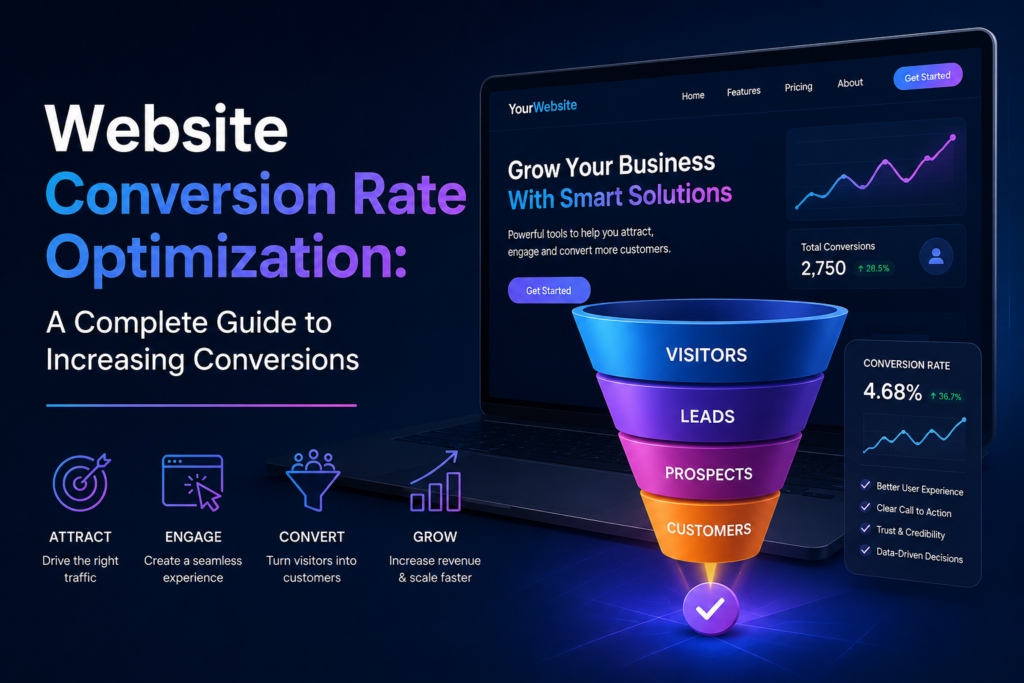
Getting visitors to your website is important, but traffic alone does not guarantee business growth. If visitors leave without making a purchase, submitting a form, booking a consultation, or taking another valuable action, your website may not be performing as effectively as it could.
This is where website conversion rate optimization (CRO) becomes essential.
Website conversion rate optimization is the process of improving your website so that a higher percentage of visitors complete a desired action. Instead of focusing only on attracting more traffic, CRO helps you get better results from the visitors you already have.
Whether you operate an ecommerce store, service business, SaaS company, professional website, or lead-generation website, an effective website conversion optimization strategy can help increase leads, sales, revenue, and return on marketing investment.
In this complete guide, you’ll learn what website CRO is, why it matters, how to calculate conversion rates, proven conversion rate optimization strategies, common mistakes, and practical ways to improve your website conversions in 2026.
What Is Website Conversion Rate Optimization?
Website Conversion Rate Optimization is the systematic process of improving a website’s design, content, user experience, navigation, landing pages, and calls-to-action to encourage more visitors to take a desired action.
A conversion can mean different things depending on your business.
For example, a conversion could be:
- Purchasing a product
- Submitting a contact form
- Requesting a quote
- Booking an appointment
- Signing up for a free trial
- Downloading an ebook
- Registering for an event
- Subscribing to a newsletter
- Calling your business
- Creating an account
The goal of CRO isn’t simply to make a website look better. It is to make the website more effective at guiding visitors toward meaningful actions.
A visually attractive website with poor conversion performance still needs optimization.
Why Is Conversion Rate Optimization Important for Websites?
Businesses invest significant amounts of money in SEO, advertising, social media, content marketing, and other channels to attract website visitors.
But what happens after visitors arrive?
If your website has unclear messaging, slow pages, confusing navigation, weak calls-to-action, or complicated forms, potential customers may leave before converting.
Conversion rate optimization helps you make better use of existing traffic.
For example, imagine your website receives 10,000 monthly visitors and generates 200 conversions. Your conversion rate is 2%.
If optimization increases the conversion rate to 3%, the same traffic could generate 300 conversions.
You don’t necessarily need 5,000 additional visitors to generate more results. You may be able to achieve growth by improving the experience for the visitors you already have.
This makes CRO particularly valuable for businesses that want to increase revenue without relying entirely on increasing advertising budgets.
How Is Website Conversion Rate Calculated?
The basic conversion rate formula is:
Conversion Rate = (Number of Conversions ÷ Number of Visitors) × 100
For example, if 5,000 people visit your website and 150 complete your desired action:
150 ÷ 5,000 × 100 = 3%
Your conversion rate would therefore be 3%.
However, conversion rates vary considerably depending on the industry, traffic source, offer, device, audience, conversion type, and business model.
Instead of focusing on an arbitrary “good” conversion rate, compare your current performance against your previous results and continuously test improvements.
12 Effective Website Conversion Rate Optimization Strategies
There is no single CRO tactic that works for every website. The most effective approach combines data analysis, user research, testing, design improvements, and compelling messaging.
Here are 12 practical CRO strategies to consider.
1. Create a Clear Value Proposition
Visitors should quickly understand what your business offers and why they should choose you.
Your homepage and important landing pages should communicate:
- What you offer
- Who you help
- The problem you solve
- Why your solution is different
- What the visitor should do next
Avoid vague headlines that sound impressive but don’t communicate a clear benefit.
Instead of simply saying “Welcome to Our Website,” use a headline that communicates the value of your product or service.
Your value proposition should answer the visitor’s most important question:
“What’s in it for me?”
2. Use Strong and Clear Calls-to-Action
A call-to-action (CTA) tells visitors what to do next.
Examples include:
- Get a Free Quote
- Book a Consultation
- Start Your Free Trial
- Shop Now
- Download the Guide
- Contact Us
- Schedule a Demo
Effective CTAs should be noticeable, specific, and relevant to the visitor’s stage in the buying journey.
Avoid using generic CTAs such as “Click Here” when a more descriptive option would communicate greater value.
3. Optimize Your Landing Pages
Landing pages play an important role in website conversion optimization.
A landing page should have a specific goal and minimize unnecessary distractions.
A strong landing page typically includes:
- A compelling headline
- Supporting subheading
- Clear value proposition
- Relevant visuals
- Benefits and features
- Social proof
- Trust signals
- Strong CTA
- Simple form when required
Make sure the message on the landing page matches the advertisement, email, or search result that brought the visitor there.
Message consistency can reduce confusion and improve the overall user experience.
4. Improve Website Speed
Website performance can have a major effect on user experience.
People expect websites to load quickly and respond smoothly. A slow website can create frustration and increase the likelihood that visitors leave before taking action.
Common ways to improve performance include:
- Compressing images
- Using modern image formats
- Reducing unnecessary scripts
- Improving hosting
- Using browser caching
- Minimizing unused code
- Optimizing fonts
- Using a content delivery network when appropriate
Website speed should be treated as both a UX and technical priority.
5. Make Your Website Mobile-Friendly
A significant portion of web traffic comes from mobile devices.
Your website should work smoothly on smartphones and tablets.
Pay particular attention to:
- Button sizes
- Font readability
- Navigation
- Form usability
- Page layouts
- Image scaling
- Pop-ups
- Checkout processes
A visitor should not have to pinch, zoom, or repeatedly scroll horizontally to use your website.
Mobile optimization is an essential part of modern website CRO.
6. Simplify Your Forms
Long or complicated forms can discourage visitors from submitting their information.
Only request information that you genuinely need at that stage of the customer journey.
For example, a simple lead-generation form might only require:
- Name
- Phone number
More detailed information can potentially be collected later.
You can also improve forms by providing clear labels, useful error messages, and reassuring privacy information.
7. Build Trust With Social Proof
Visitors may hesitate to purchase or contact a business they don’t know.
Trust signals can reduce this hesitation.
Consider adding:
- Customer reviews
- Testimonials
- Case studies
- Client logos
- Industry certifications
- Awards
- Security information
- Guarantees
- Media mentions
Testimonials are particularly powerful when they explain a specific problem and the result achieved by the customer.
Instead of simply displaying “Great service!”, provide context about what the customer purchased or experienced.
8. Improve Website Navigation
Visitors should be able to find important information without unnecessary effort.
Your navigation should make it easy to access:
- Products
- Services
- About information
- Pricing
- Resources
- Contact details
Avoid overwhelming visitors with too many navigation options.
Organize information logically and use familiar terminology.
Good navigation helps visitors move through your website with confidence.
9. Address Customer Objections
Potential customers often have questions or concerns before converting.
Your website should proactively answer them.
Depending on your business, visitors may want to know:
- How much does it cost?
- How does it work?
- How long does delivery take?
- Is there a guarantee?
- Can I cancel?
- Is my payment secure?
- What happens after I submit the form?
- Why should I choose your company?
An FAQ section can be useful, but don’t hide critical information only inside an FAQ.
Important objections should be addressed directly on relevant product, service, or landing pages.
10. Use High-Quality Visuals
Images, videos, diagrams, screenshots, and other visual elements can help visitors understand your offering.
However, visuals should support the conversion goal rather than simply decorate the page.
For ecommerce websites, product photography is particularly important.
For service businesses, consider using:
- Team photographs
- Before-and-after examples
- Process diagrams
- Case study visuals
- Demonstration videos
Always optimize image file sizes to avoid unnecessarily slowing down your website.
11. Reduce Friction in the Customer Journey
Every unnecessary step creates another opportunity for visitors to abandon the process.
Review your conversion journey from beginning to end.
For example:
Ad → Landing Page → Form → Confirmation → Sales Follow-Up
Ask yourself:
- Is every step necessary?
- Is the next action obvious?
- Are there unnecessary fields?
- Does the page load quickly?
- Are visitors receiving enough information?
- Are there unexpected costs?
- Is the checkout process simple?
Reducing friction is one of the fundamental principles of conversion optimization.
12. Conduct A/B Testing
Don’t rely entirely on assumptions.
A/B testing allows you to compare different versions of a webpage element and determine which performs better.
You might test:
- Headlines
- CTA text
- CTA placement
- Images
- Form length
- Page layouts
- Pricing presentation
- Product descriptions
- Testimonials
However, avoid changing too many variables simultaneously if you want to understand what caused the performance difference.
CRO should be treated as an ongoing process of learning and improvement.
How to Optimize Your Website for More Conversions
Effective CRO starts with understanding your visitors.
Before changing your website, collect data.
Use analytics to identify:
- Your highest-traffic pages
- Pages with high exit rates
- Conversion paths
- Traffic sources
- Device usage
- Returning visitors
- New visitors
- Top landing pages
You can then combine quantitative data with qualitative feedback.
For example, analytics may tell you that many users abandon a particular page. User testing or customer feedback may help explain why.
This combination of data and user insight can make your website conversion rate optimization efforts much more effective.
Website Conversion Optimization for Mobile Users
Mobile CRO deserves special attention.
A desktop design cannot simply be shrunk onto a smartphone screen.
Mobile users may have different needs, behaviors, and constraints.
Make sure mobile visitors can:
- Read your content easily
- Navigate quickly
- Tap buttons comfortably
- Complete forms
- Call your business
- Make purchases
- Access important information
Consider using mobile-specific CTAs where appropriate.
For example, a local service business may benefit from a prominent “Call Now” or “Get Directions” option for mobile visitors.
How Landing Page Optimization Improves Conversions
Landing page optimization is one of the most important areas of CRO.
A landing page should focus on a specific audience and objective.
For example, instead of sending an advertising visitor to a generic homepage, you could create a dedicated landing page that directly addresses the product, service, or offer mentioned in the advertisement.
An effective landing page should maintain a logical flow:
Problem → Solution → Benefits → Proof → CTA
The visitor should understand what you offer, why it matters, why they should trust you, and what action they should take.
Common Website CRO Mistakes to Avoid
Even businesses investing in CRO can make mistakes.
Optimizing Based on Guesswork
Don’t assume you know what users want. Use data, research, and testing.
Focusing Only on Design
A beautiful website isn’t automatically a high-converting website.
Design should support usability and business objectives.
Making Too Many Changes at Once
If you change everything simultaneously, it becomes difficult to determine which changes affected performance.
Ignoring Mobile Users
Always evaluate your website on real mobile devices and different screen sizes.
Using Too Many Pop-Ups
Aggressive pop-ups can interrupt the user experience and frustrate visitors.
Hiding Important Information
Don’t force visitors to search for pricing, shipping information, contact details, or other essential information.
Ignoring Existing SEO Traffic
CRO changes should not accidentally damage organic search performance.
When modifying URLs, content, navigation, or page structures, consider SEO implications.
How to Measure Conversion Rate Optimization Success
CRO should be measured using meaningful business metrics.
Depending on your website, track:
- Conversion rate
- Leads generated
- Sales
- Revenue
- Average order value
- Cost per lead
- Customer acquisition cost
- Form completion rate
- Cart abandonment
- Bounce or engagement metrics
- Return on advertising spend
Don’t focus on one metric in isolation.
For example, a change that increases form submissions but dramatically reduces lead quality may not actually improve business performance.
The ultimate objective is not simply more conversions.
It is more valuable conversions.
Best Tools for Website Conversion Rate Optimization
A combination of tools can help you understand and improve website performance.
Common categories include:
Analytics Tools
These help you understand traffic, user behavior, conversions, and acquisition sources.
Heatmap and Session Recording Tools
These can help you understand where users click, scroll, and interact with your pages.
A/B Testing Tools
These allow you to compare different versions of pages or website elements.
SEO Tools
SEO platforms can help identify organic search opportunities, technical issues, keywords, and competitors.
User Research Tools
Surveys, interviews, usability testing, and customer feedback can reveal problems that analytics alone cannot explain.
The right toolset depends on your website size, budget, technical resources, and objectives.
Website Conversion Rate Optimization Checklist
Use this checklist when reviewing your website:
- Is the value proposition immediately clear?
- Does every important page have a clear CTA?
- Are landing pages focused on one primary objective?
- Is the website fast?
- Is it mobile-friendly?
- Is navigation simple?
- Are forms easy to complete?
- Are customer objections addressed?
- Are testimonials and reviews visible?
- Are trust signals displayed?
- Are product and service benefits clear?
- Is important information easy to find?
- Are images optimized?
- Are analytics and conversion tracking configured?
- Are you regularly testing improvements?
- Are conversions producing quality leads or customers?
How Often Should You Perform Conversion Rate Optimization?
CRO shouldn’t be treated as a one-time project.
Your website, customers, competitors, traffic sources, and market conditions constantly change.
A better approach is to create an ongoing optimization cycle:
Analyze → Identify → Hypothesize → Test → Measure → Improve → Repeat
Start with the pages that have the greatest potential impact.
For example, a high-traffic landing page with a poor conversion rate may represent a better optimization opportunity than a low-traffic page that already performs well.
Over time, small improvements can compound into significant business results.
Final Thoughts: Make Every Website Visitor Count
Attracting visitors is only the beginning of successful digital marketing.
The real opportunity lies in what happens after someone reaches your website.
Website Conversion Rate Optimization helps businesses transform more of their existing traffic into meaningful outcomes, whether those outcomes are leads, purchases, bookings, subscriptions, or enquiries.
The most effective approach isn’t to make random design changes. Instead, use analytics, customer research, UX principles, compelling content, clear CTAs, testing, and continuous improvement.
Start by identifying where visitors are dropping out of your conversion funnel. Then prioritize the pages and problems that can have the biggest impact on your business.
Remember:
More traffic isn’t always the answer. Sometimes, the better opportunity is to convert more of the traffic you already have.
In 2026, businesses that combine strong traffic acquisition with effective conversion rate optimization strategies will be better positioned to turn website visitors into loyal customers and achieve sustainable online growth.
Leave a Reply