Local SEO vs Traditional SEO: What’s the Difference?
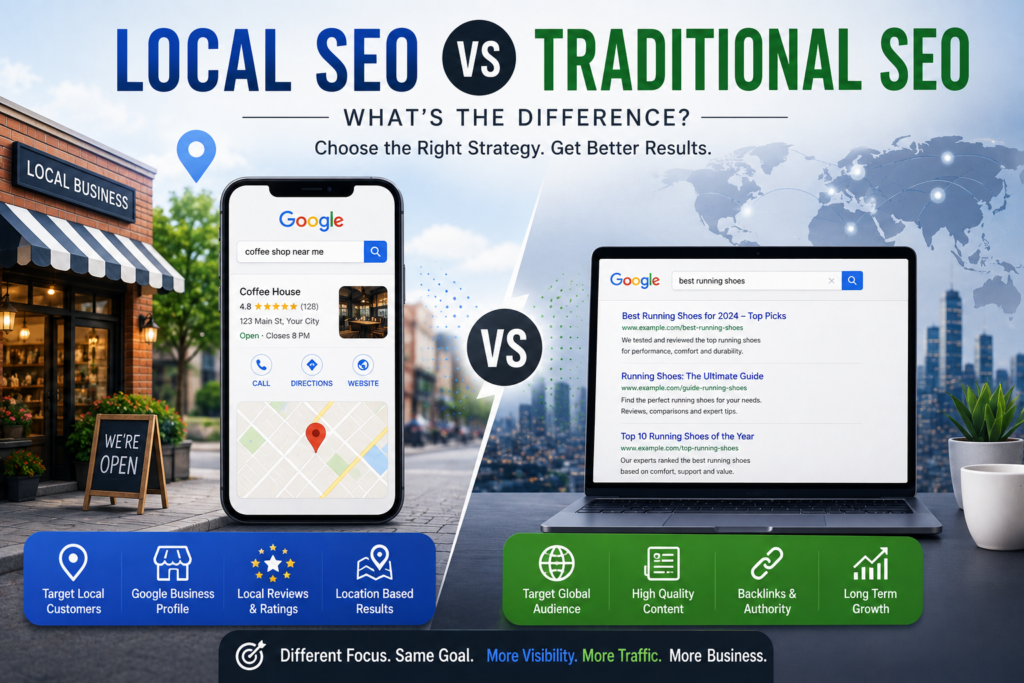
If you want your business to grow online, showing up in search engines is essential. But not every business needs the same SEO strategy. A local restaurant, dental clinic, law firm, plumber, or digital agency serving a specific city has very different search visibility goals from an eCommerce store or SaaS company targeting customers across the country.
This is where the difference between Local SEO vs Traditional SEO becomes important.
Both strategies aim to improve a website’s visibility in search engines and attract relevant organic traffic. However, Local SEO focuses primarily on geographic searches and customers in specific locations, while traditional SEO, often referred to as organic SEO, focuses more broadly on improving website rankings for relevant searches regardless of the searcher’s physical location.
So, which strategy should your business use?
The answer depends on your business model, target audience, service area, competition, and growth goals. In many cases, the best approach is actually to use Local SEO and Traditional SEO together.
In this guide, we’ll explain the difference between Local SEO and Traditional SEO, their benefits, key strategies, ranking factors, and how to determine which approach is right for your business.
What Is Local SEO?
Local SEO is the process of optimizing a business’s online presence so it becomes more visible to people searching for products or services in a specific geographic area.
For example, someone searching for:
- “SEO agency near me”
- “best dentist in Guwahati”
- “restaurants near me”
- “plumber in Delhi”
- “digital marketing agency in Mumbai”
has a local search intent.
The person isn’t necessarily looking for the best business anywhere in the world. They want a business that can serve them in their location.
Local SEO therefore focuses on signals that help search engines understand where a business operates and which local customers it serves.
Important components of Local SEO include:
- Google Business Profile optimization
- Local keyword targeting
- Online reviews
- Local citations
- Location pages
- Local backlinks
- NAP consistency
- Local content
- Google Maps visibility
For businesses that depend on customers visiting a physical location or serving a particular geographic area, Local SEO can be extremely valuable.
What Is Traditional SEO?
Traditional SEO, commonly called organic SEO, is the broader process of improving a website’s visibility in unpaid search engine results.
Unlike Local SEO, traditional SEO does not necessarily depend on a specific geographic location.
For example, a software company may want to rank for:
- “project management software”
- “email marketing automation”
- “best CRM software”
- “SEO tools”
- “website optimization tips”
These searches can come from users anywhere.
Traditional SEO typically involves:
- Keyword research
- Technical SEO
- On-page SEO
- Content marketing
- Internal linking
- Link building
- Website architecture
- Search intent optimization
- Content optimization
- User experience improvements
The primary objective is to increase relevant organic traffic and ultimately generate leads, sales, subscriptions, or other business outcomes.
Local SEO vs Traditional SEO: Key Differences
Understanding the Local SEO vs Traditional SEO comparison becomes easier when you look at what each strategy is designed to accomplish.
1. Target Audience and Geographic Focus
The biggest difference is geographic targeting.
Local SEO focuses on customers in specific locations.
For example:
“Web design company in Guwahati”
Traditional SEO may target a broader search such as:
“Best web design company”
A local business may want to dominate searches in one city, while an online business may want visibility across multiple cities, states, countries, or globally.
2. Keyword Targeting
Local SEO often uses location-specific keywords.
Examples include:
- SEO agency in Guwahati
- restaurant in Bangalore
- accountant near me
- digital marketing agency in Delhi
Traditional SEO may target broader keywords such as:
- SEO services
- digital marketing strategy
- technical SEO guide
- content marketing
- website optimization
However, the two strategies can overlap.
A local company can use traditional SEO to rank for broader informational keywords while using Local SEO to attract customers searching specifically within its service area.
3. Search Results and Rankings
Traditional SEO primarily focuses on organic search results.
Local SEO also targets organic results but has an additional focus on local search features such as Google Maps and the local pack.
When someone searches for a local service, search engines may display a map and a selection of local businesses.
This creates an additional opportunity for local businesses to gain visibility without necessarily ranking first for a traditional organic keyword.
4. Google Business Profile vs Website Rankings
One major distinction in Local SEO vs organic SEO is the importance of the Google Business Profile.
A properly optimized Google Business Profile can help eligible businesses appear in local search results and Google Maps.
Traditional SEO, on the other hand, is primarily concerned with improving the visibility of website pages in organic search results.
For a local business, both can be important.
Your website may rank organically for valuable keywords while your business profile attracts customers through local search and Maps.
5. Local Citations and Backlinks
Local SEO often involves citations—mentions of a business’s name, address, phone number, and other information on relevant online directories or platforms.
Consistency is important.
For example, if your business name and address appear differently across multiple websites, it can create confusion for users and search engines.
Traditional SEO focuses more broadly on earning relevant backlinks and building website authority.
While backlinks are important for both approaches, Local SEO can benefit from links and mentions from locally relevant websites such as:
- Local news publications
- Business associations
- Community websites
- Local directories
- Industry organizations
- Regional blogs
6. Content Strategy
Traditional SEO often involves creating comprehensive content designed to answer informational, commercial, and transactional searches.
Local SEO can use a similar strategy but adds geographic relevance.
For example, a national SEO agency might publish:
“The Complete Guide to Technical SEO.”
A local agency might also publish:
“Complete SEO Guide for Small Businesses in Guwahati.”
Both can be useful, but the second article has a stronger local intent.
7. Reviews and Reputation
Reviews play an especially important role in local search.
Customers frequently evaluate businesses based on:
- Number of reviews
- Review quality
- Recent reviews
- Business responses
- Overall reputation
For restaurants, clinics, service providers, retail stores, and other local businesses, online reputation can influence both visibility and customer decisions.
Traditional SEO doesn’t usually depend on customer reviews to the same extent.
Why Local SEO Is Important for Local Businesses
If your customers need to visit your location or you provide services within a defined geographic area, Local SEO can be one of the most effective ways to generate relevant leads.
Improve Visibility in Local Search
When customers search for a service in your area, you want your business to be visible.
Local SEO helps search engines understand your:
- Business category
- Location
- Service area
- Products or services
- Business information
Attract High-Intent Customers
Local searches often have strong commercial intent.
Someone searching for “emergency plumber near me” is likely looking for a solution now.
Similarly, searches such as “dentist near me” or “best restaurant near me” often indicate that the user is actively considering a business.
Increase Google Maps Visibility
For location-based businesses, visibility in Google Maps can be extremely valuable.
A customer may discover your business through Maps, read reviews, check opening hours, visit your website, call your business, or request directions.
Generate Calls, Directions and Website Visits
A successful Local SEO campaign isn’t only about website traffic.
The real business outcomes can include:
- Phone calls
- Store visits
- Direction requests
- Appointment bookings
- Website visits
- Quote requests
- Local leads
- Purchases
This is why businesses should measure conversions rather than focusing only on rankings.
Why Traditional SEO Is Important for Online and National Businesses
Traditional SEO is particularly valuable when your target audience isn’t limited to one geographic area.
Increase Organic Website Traffic
A strong SEO strategy can help your website rank for hundreds or thousands of relevant searches.
Instead of paying for every visitor through advertising, organic rankings can generate ongoing traffic.
Build Long-Term Search Visibility
SEO can create a compounding effect.
A useful article may rank for multiple keywords and continue attracting visitors over time.
As your website publishes more high-quality content and earns authority, its overall organic visibility can increase.
Reach a Wider Audience
Traditional SEO allows businesses to target customers across:
- Cities
- States
- Countries
- International markets
This makes it especially useful for eCommerce companies, SaaS businesses, publishers, online education companies, and national service providers.
Build Topical Authority
Publishing high-quality content around a particular subject can help establish your website as a valuable resource.
For example, a digital marketing company might create content covering:
- SEO
- Content marketing
- Technical SEO
- Local SEO
- Link building
- Conversion optimization
- Website performance
This broader content ecosystem supports a long-term organic SEO strategy.
Local SEO vs Traditional SEO: Which One Should You Choose?
There isn’t one universal answer.
The right strategy depends on your business.
Choose Local SEO If You Own a Local Business
Local SEO should be a priority if you operate:
- Restaurants
- Dental clinics
- Medical practices
- Law firms
- Real estate agencies
- Plumbers
- Electricians
- Salons
- Gyms
- Local retail stores
- Home service businesses
If customers search for businesses based on location, Local SEO should be part of your marketing strategy.
Choose Traditional SEO If You Target a National or Global Audience
Traditional SEO may be more important if your business sells online or serves customers across a large geographic area.
Examples include:
- SaaS companies
- eCommerce stores
- Online courses
- Technology companies
- Publishers
- National brands
- Online service providers
Use Both If Your Business Serves Local and Online Customers
Many businesses don’t need to choose only one.
For example, a digital marketing agency could use Local SEO to rank for:
“digital marketing agency in Guwahati”
while using traditional SEO to rank for:
“digital marketing strategy for small businesses.”
This combination can generate both local leads and broader organic traffic.
Local SEO Strategies That Drive Results
If you want to improve your local search optimization, focus on several core areas.
Optimize Your Google Business Profile
Make sure your business information is complete and accurate.
Pay attention to:
- Business category
- Business description
- Address
- Phone number
- Website
- Business hours
- Photos
- Services
- Products where applicable
Keep the profile updated as your business changes.
Build Local Citations
Create consistent business listings on relevant directories and platforms.
Ensure important business information remains accurate across the web.
Create Location-Based Content
Create genuinely useful content for your local audience.
For example:
- Local guides
- Service-area pages
- City-specific landing pages
- Local industry resources
- FAQs for local customers
Avoid creating dozens of nearly identical location pages simply by replacing city names.
Each page should provide genuine value.
Earn Local Backlinks
Build relationships with relevant local organizations, publications, businesses, and communities.
A locally relevant link can support both visibility and authority.
Generate and Manage Customer Reviews
Encourage genuine customers to leave honest feedback.
Respond professionally to reviews, including negative reviews.
Never buy fake reviews or manipulate customer feedback.
Optimize for “Near Me” Searches
People often use phrases such as “near me” when looking for local businesses.
Rather than stuffing “near me” repeatedly into your content, make sure your business information, location signals, website content, and local profile are accurate and useful.
Search engines can use contextual signals to understand geographic relevance.
Traditional SEO Strategies That Drive Results
A strong traditional SEO strategy usually includes several foundational components.
Keyword Research
Identify keywords based on:
- Search intent
- Relevance
- Competition
- Business value
- Search demand
Don’t focus exclusively on high-volume keywords.
A lower-volume keyword with strong buying intent can sometimes generate more business value.
On-Page SEO
Optimize important elements such as:
- Title tags
- Headings
- URLs
- Content
- Images
- Internal links
- Meta descriptions
The goal should be to make each page useful and easy for both users and search engines to understand.
Technical SEO
Technical SEO helps search engines crawl, render, index, and understand your website.
Areas to monitor include:
- Site speed
- Mobile usability
- Indexing
- XML sitemaps
- Canonical URLs
- Redirects
- Structured data
- Broken links
- Website architecture
Content Marketing
Create content that addresses the questions and problems your audience actually has.
Useful content can attract search traffic, build authority, support internal linking, and generate leads.
Link Building
Earn relevant links from credible websites.
Focus on quality, relevance, and genuine value rather than simply trying to increase the number of backlinks.
Internal Linking
Connect related pages across your website.
Internal links help users discover additional information and can help search engines understand the relationships between pages.
Can You Use Local SEO and Traditional SEO Together?
Absolutely.
In fact, combining both can create a powerful SEO strategy.
Consider a local web design agency.
Its Local SEO strategy could target:
“web design company in Guwahati.”
Its traditional SEO strategy could target:
“how much does a website cost?”
The local page can attract customers ready to hire a nearby provider, while the informational article can attract people researching website costs.
These visitors are at different stages of the buying journey.
Together, the strategies can create a broader organic acquisition funnel.
Local SEO vs Traditional SEO: Which Is More Effective?
Neither strategy is automatically better.
Local SEO is more effective for businesses that depend on geographic visibility.
Traditional SEO is more effective for businesses targeting broader audiences.
For many companies, the most effective strategy is a combination.
The key question isn’t:
“Which SEO strategy is better?”
Instead, ask:
“Where are my customers searching, and what type of search intent do they have?”
If your customers search for businesses based on location, prioritize Local SEO.
If your customers search for information, products, or services without geographic limitations, traditional SEO may be more appropriate.
If you serve both audiences, combine the two.
Common SEO Mistakes Businesses Should Avoid
Regardless of the SEO strategy you choose, avoid common mistakes such as:
- Keyword stuffing
- Publishing low-quality content
- Buying spammy backlinks
- Creating duplicate location pages
- Ignoring mobile users
- Neglecting technical SEO
- Having inconsistent business information
- Buying fake reviews
- Focusing only on rankings
- Ignoring conversions
- Expecting immediate results
SEO is a long-term strategy.
Sustainable results usually come from consistently improving your website and providing a better experience for your target audience.
How Long Does Local SEO Take to Work?
Local SEO results can vary significantly.
Some businesses may see improvements within a few weeks or months after correcting important profile, website, or technical issues. More competitive local markets can require considerably longer.
Your timeline may depend on:
- Local competition
- Existing website authority
- Business profile quality
- Review profile
- Local citations
- Content quality
- Backlinks
- Website health
- Search demand
The best approach is to track progress through rankings, impressions, calls, website visits, direction requests, leads, and conversions.
How Long Does Traditional SEO Take to Work?
Traditional SEO also doesn’t have a fixed timeline.
New websites and highly competitive industries may require several months of consistent work before significant results appear.
Established websites with strong authority may see improvements faster, particularly when optimizing pages that are already ranking close to the top.
SEO should therefore be viewed as an ongoing investment rather than a one-time project.
Frequently Asked Questions
Is Local SEO better than traditional SEO?
Not necessarily. Local SEO is better suited to businesses targeting customers in specific geographic areas, while traditional SEO is generally better for businesses targeting broader audiences. Many businesses benefit from using both.
What is the difference between local SEO and organic SEO?
The primary difference is geographic intent. Local SEO focuses on visibility for searches connected to specific locations, while organic SEO focuses more broadly on improving website rankings for relevant searches.
Can a business use both Local SEO and Traditional SEO?
Yes. Combining both strategies can help a business attract local customers while also generating broader organic traffic.
Is Local SEO cheaper than traditional SEO?
There is no universal cost difference. Pricing depends on the competitiveness of the market, business goals, website condition, services required, content needs, competition, and scope of the campaign.
Does Local SEO help Google rankings?
Yes. Local SEO can help eligible businesses improve their visibility in relevant local search results. However, rankings depend on many factors, and no legitimate SEO provider can guarantee a specific position.
Which SEO strategy is best for a small business?
For a small business serving a specific geographic area, Local SEO is often an important starting point. Traditional SEO can then be added to target broader informational and commercial searches.
Final Thoughts: Choosing the Right SEO Strategy for Your Business
The Local SEO vs Traditional SEO debate isn’t really about choosing one strategy over another.
It’s about understanding your customers and where they search.
If your business depends on customers in a specific city, region, or service area, Local SEO can help you become more visible when potential customers are actively searching for nearby products and services.
If your business serves customers nationally or internationally, traditional SEO can help you build organic visibility across a much larger audience.
And if your business serves both local and broader audiences, combining Local SEO and Traditional SEO can give you the best of both worlds.
The most effective SEO strategy starts with your business goals, not a checklist of tactics.
Understand your audience. Research their search behavior. Create useful content. Optimize your website. Build authority. Maintain accurate business information. Track conversions—not just rankings.
When these elements work together, SEO becomes more than a way to increase website traffic. It becomes a sustainable channel for generating visibility, leads, customers, and long-term business growth.
Leave a Reply