How to Get More Leads From Google: 15 Proven Strategies for 2026
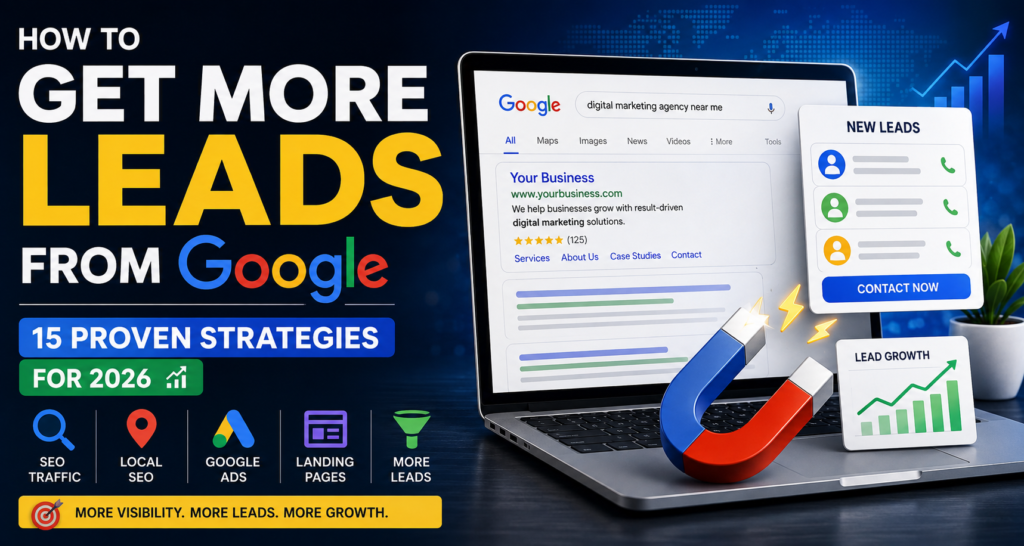
If your business depends on a steady flow of customers, Google can be one of your most valuable sources of leads. Every day, potential customers search for products, services, solutions, and businesses that can solve their problems. The challenge is getting your business in front of those people—and then turning that visibility into actual inquiries, calls, bookings, and sales.
So, how do you get more leads from Google?
The answer isn’t simply “rank higher.” A successful Google lead generation strategy combines SEO, high-intent keywords, local search optimization, compelling content, Google Business Profile optimization, conversion-focused landing pages, and paid advertising.
In this guide, we’ll explore 15 proven strategies to get more leads from Google in 2026, including ways to generate organic leads without paying for every click and methods for converting Google visitors into qualified prospects.
Keyword note: The primary keyword for this article is “How to Get More Leads From Google.” The phrase “Local SEO vs Traditional SEO” is included naturally where the two approaches are relevant rather than forcing an unrelated keyword into the content.
What Does It Mean to Get Leads From Google?
Getting leads from Google means attracting people who are actively searching for your products or services and encouraging them to take a valuable action.
A lead could be someone who:
- Fills out a contact form
- Calls your business
- Requests a quote
- Books an appointment
- Requests a consultation
- Downloads a resource
- Starts a free trial
- Sends a WhatsApp message
- Makes an inquiry
- Purchases a product
For example, if you operate a web design agency and someone searches for “web design company near me,” you have an opportunity to appear in front of a high-intent potential customer.
The goal isn’t simply to generate traffic.
It’s to generate qualified traffic that converts into business opportunities.
How Google Can Help Your Business Generate More Leads
Google can generate leads through several channels, including:
- Organic search results
- Google Maps
- Google Business Profile
- Google Ads
- Featured search results
- Local search results
- Informational content
- Product results
A strong strategy combines multiple channels.
For example:
SEO → Organic traffic → Landing page → Lead form → Sales follow-up
Or:
Google Business Profile → Local search → Phone call → Customer
Or:
Google Ads → High-intent keyword → Landing page → Consultation request
The best approach depends on your business model, audience, competition, location, and budget.
15 Ways to Get More Leads From Google
1. Optimize Your Website for Search Intent
One of the most important principles of Google lead generation is understanding search intent.
People use Google for different reasons.
They may want to:
- Learn something
- Compare options
- Find a specific company
- Purchase a product
- Hire a service
- Find a local business
For example:
“What is SEO?”
has informational intent.
But:
“SEO agency for small business”
has stronger commercial intent.
And:
“SEO agency near me”
may have strong local and transactional intent.
Your content should match the reason behind the search.
If someone searches for a service, don’t send them to a generic blog post. Send them to a relevant service or landing page.
Matching search intent can improve both rankings and conversions.
2. Target High-Intent Keywords
Not every keyword is equally valuable.
A keyword might have thousands of monthly searches but generate very few customers.
Another keyword might have only a few hundred searches but produce highly qualified leads.
For lead generation, focus heavily on commercial and transactional keywords.
Examples include:
- SEO agency
- Web design company
- Digital marketing services
- Buy running shoes online
- Business accounting services
- Real estate agent near me
- Emergency plumber
- Website development company
These searches often indicate that the person is closer to making a purchasing decision.
Build keyword groups around the customer journey
Informational:
“What is SEO?”
Commercial:
“Best SEO services for small businesses”
Transactional:
“SEO agency pricing”
Local:
“SEO company in Guwahati”
A strong content strategy can target all four stages.
3. Create Helpful, SEO-Friendly Content
Content is one of the most effective ways to generate organic leads from Google.
But publishing content simply for the sake of increasing word count isn’t enough.
Your content should solve real problems.
Create:
- How-to guides
- Comparison articles
- Case studies
- Buying guides
- Industry reports
- FAQs
- Tutorials
- Service guides
- Original research
For example, a digital marketing agency could create:
“How Much Does SEO Cost in 2026?”
The article can attract people researching SEO services and provide opportunities to introduce the company’s services.
Every article should have a logical next step.
That might be:
“Get a Free SEO Audit”
or:
“Book a Consultation.”
4. Optimize Your Google Business Profile
For businesses serving specific geographic areas, Google Business Profile can be a powerful source of leads.
A well-maintained profile can help potential customers discover your business when searching for relevant local products and services.
Make sure your profile information is accurate and complete.
Pay attention to:
- Business name
- Primary category
- Business description
- Address
- Phone number
- Website
- Business hours
- Services
- Photos
- Customer reviews
Keep information updated.
Add appropriate photos and respond professionally to customer reviews.
For local businesses, this can create opportunities for:
- Phone calls
- Website visits
- Direction requests
- Appointment bookings
- Store visits
5. Improve Your Local SEO
If you serve customers in a specific city or geographic area, Local SEO should be part of your lead-generation strategy.
Local SEO helps businesses become more visible for searches with geographic intent.
Examples include:
- Dentist in Delhi
- Restaurant in Bangalore
- Digital marketing agency in Guwahati
- Plumber near me
- Real estate agent in Mumbai
Local SEO vs Traditional SEO
The difference is primarily in the type of visibility you’re pursuing.
Local SEO focuses on geographic searches, Google Maps, local results, location pages, reviews, and local business signals.
Traditional SEO focuses more broadly on improving organic rankings for relevant searches regardless of geographic location.
A local service business may benefit heavily from Local SEO, while a SaaS company selling internationally may focus more heavily on traditional organic SEO.
Many businesses can benefit from both.
6. Create High-Converting Landing Pages
Getting visitors from Google is only half the process.
Your landing page must persuade them to take action.
A high-converting landing page should quickly communicate:
What do you offer?
Who is it for?
Why should the visitor choose you?
What should they do next?
Include:
- Strong headline
- Clear value proposition
- Benefits
- Relevant images
- Social proof
- Testimonials
- Case studies
- FAQs
- Clear CTA
Avoid distracting visitors with too many competing offers.
The page should guide them toward one primary conversion.
7. Optimize Your Website for Lead Generation
Your entire website should support lead generation—not just your contact page.
Give visitors multiple opportunities to contact your business.
Depending on your business, these could include:
- Contact forms
- Phone numbers
- Quote buttons
- Consultation bookings
- Live chat
- Newsletter signup
- Demo requests
Place relevant CTAs throughout the customer journey.
For example, an educational blog article could include:
Need Help With SEO? Get a Free Website Audit.
That turns informational traffic into a potential business opportunity.
8. Improve Your Website’s Conversion Rate
Suppose your website receives 10,000 visitors per month but generates only 20 leads.
Increasing traffic isn’t necessarily your first priority.
Improving your conversion rate might generate more leads from the traffic you already have.
Review:
- Headlines
- CTAs
- Forms
- Page speed
- Navigation
- Mobile experience
- Trust signals
- Pricing information
- Service pages
- Landing pages
Your goal is to reduce friction.
Make it easy for visitors to understand your offer and take the next step.
9. Use Strong Calls to Action
A visitor may be interested in your service but still leave because you haven’t clearly told them what to do.
Weak CTAs include:
Submit
Click Here
Learn More
Sometimes these are appropriate, but stronger CTAs can communicate value more effectively.
Consider:
- Get My Free Consultation
- Request a Free Quote
- Book a Strategy Call
- Start Your Free Trial
- Get a Free SEO Audit
- Talk to an Expert
Test different calls to action and monitor which ones produce more conversions.
10. Build High-Quality Backlinks
Backlinks can help establish website authority and improve organic search visibility.
But don’t focus on obtaining as many links as possible.
Focus on earning relevant and trustworthy links.
Potential strategies include:
- Digital PR
- Industry publications
- Expert contributions
- Original research
- Statistics pages
- Resource guides
- Partnerships
- Local organizations
- Relevant directories
For a local business, locally relevant backlinks can be particularly useful.
For example, a local company might earn mentions from:
- Regional publications
- Business associations
- Local organizations
- Industry events
- Community websites
Quality and relevance matter more than simply accumulating links.
11. Target Long-Tail Keywords
Long-tail keywords are usually more specific search phrases.
Examples:
“SEO”
versus:
“SEO services for small businesses in Guwahati.”
The second phrase has a much clearer intent.
Long-tail keywords may have lower search volume, but they can be extremely valuable for lead generation because they often attract more targeted visitors.
Look for keywords containing phrases such as:
- For small businesses
- Near me
- In [location]
- Pricing
- Cost
- Services
- Company
- Agency
- Consultant
- Best
- Compare
These can reveal strong commercial opportunities.
12. Optimize Existing Content for Better Rankings
You don’t always need to create another article.
Sometimes the best way to generate more leads from Google is to improve content you already have.
Look for pages that:
- Already receive organic traffic
- Rank on page two
- Rank for multiple related keywords
- Have high impressions but low clicks
- Generate traffic but few conversions
Then improve them.
You could:
- Update outdated information
- Improve headings
- Add missing sections
- Answer additional questions
- Improve internal links
- Strengthen CTAs
- Improve title tags
- Add relevant examples
- Improve readability
Moving an existing page from position 12 to position 6 can potentially create significant additional visibility.
13. Use Google Ads to Generate Immediate Leads
SEO is a long-term strategy.
Google Ads can provide much faster visibility.
You can target searches with strong commercial intent and send users directly to dedicated landing pages.
For example:
“emergency plumber near me”
could trigger an advertisement for a plumbing company.
Google Ads can be especially useful when:
- You’re launching a new business
- Your SEO rankings aren’t established
- You need leads quickly
- You’re testing a new market
- You’re promoting a time-sensitive offer
However, paid traffic requires careful optimization.
Track:
Ad spend → Clicks → Leads → Qualified leads → Customers → Revenue
Don’t judge campaigns based only on clicks.
14. Build Trust With Reviews, Testimonials and Case Studies
People are more likely to contact businesses they trust.
Your website should demonstrate credibility.
Useful trust signals include:
- Customer reviews
- Testimonials
- Case studies
- Client logos
- Industry certifications
- Awards
- Results
- Guarantees where appropriate
- Transparent business information
For example, instead of simply saying:
“We provide SEO services.”
you could show:
“How We Increased Organic Leads by 137% for a B2B Client.”
Specific evidence is more persuasive than generic marketing claims.
For local businesses, genuine customer reviews can also play an important role in the overall customer decision-making process.
15. Track Your Google Leads and Optimize Your Strategy
You can’t improve what you don’t measure.
Set up proper tracking for:
- Organic traffic
- Keyword rankings
- Search impressions
- Click-through rate
- Landing-page conversions
- Form submissions
- Phone calls
- Bookings
- Google Ads leads
- Cost per lead
- Qualified leads
- Sales
Most importantly, distinguish between leads and qualified leads.
100 low-quality inquiries aren’t necessarily better than 20 high-quality prospects.
Your ultimate goal is not simply more leads.
It’s more qualified leads that become customers.
SEO vs Google Ads: Which Is Better for Lead Generation?
There is no universal winner.
SEO is generally better suited to long-term organic growth.
Google Ads can provide faster visibility when you have an appropriate budget and a profitable offer.
SEO advantages
- Long-term organic visibility
- Compounding content value
- No direct cost per organic click
- Builds authority
- Can generate consistent traffic
Google Ads advantages
- Immediate visibility
- Precise targeting
- Fast testing
- Strong commercial intent targeting
- Easier to scale when campaigns are profitable
For many businesses, combining both creates a stronger acquisition system.
Use Google Ads to generate immediate opportunities while building SEO as a long-term organic acquisition channel.
How to Get More Local Leads From Google
If your business operates in a specific geographic area, focus heavily on local search.
Start by optimizing your Google Business Profile.
Then:
- Target local keywords.
- Create useful location-specific content.
- Build relevant local citations.
- Earn local backlinks.
- Generate genuine customer reviews.
- Create useful service-area pages.
- Keep your business information consistent.
- Optimize your website for mobile users.
- Add clear contact and location information.
- Track calls and local conversions.
Don’t create dozens of low-quality pages simply by replacing one city name with another.
Location pages should provide unique value.
How to Create a Website That Converts Google Visitors Into Leads
A successful Google lead generation strategy requires more than SEO.
Your website needs to convert the traffic you’re generating.
Create Clear Value Propositions
Tell visitors exactly what you do and why it matters.
Avoid vague statements.
Instead of:
“Innovative solutions for tomorrow’s businesses.”
Try:
“Generate More Qualified Leads With Conversion-Focused Websites.”
Make Your Contact Forms Simple
Only request information you genuinely need.
Long forms can discourage potential leads.
Add Multiple Conversion Opportunities
Different visitors prefer different ways of contacting a business.
Offer options such as:
- Call
- Form
- Chat
- Booking
Optimize Your Website for Mobile
A visitor should be able to browse your site, understand your offer, and contact you easily from a smartphone.
Improve Website Speed
Slow websites create friction and can negatively affect both user experience and search performance.
Optimize images, scripts, hosting, caching, and unnecessary third-party elements.
How Long Does It Take to Get Leads From Google?
There’s no universal timeline.
Google Ads can potentially generate leads shortly after a campaign launches if your targeting, offer, landing page, and budget are effective.
SEO usually takes longer.
A new website may require several months of consistent SEO work before generating substantial organic leads.
Factors include:
- Website authority
- Keyword competition
- Content quality
- Technical SEO
- Backlinks
- Industry
- Location
- Search demand
- Conversion rate
Instead of asking only “How quickly can I rank?”, ask:
“How quickly can I build a reliable system that produces qualified leads?”
That mindset produces a much more sustainable strategy.
How to Measure Leads From Google
Organic Traffic
Track how many visitors arrive through unpaid Google search.
But remember: traffic isn’t the final goal.
Keyword Rankings
Monitor important commercial and informational keywords.
Look at overall trends rather than daily fluctuations.
Search Impressions
Increasing impressions can indicate that Google is showing your website for more searches.
Click-Through Rate
CTR tells you how frequently people click your result after seeing it.
A compelling title and description can improve clicks.
Conversion Rate
Measure the percentage of visitors who become leads.
For example:
1,000 visitors → 40 leads = 4% conversion rate.
Cost Per Lead
For Google Ads, calculate how much you’re spending to acquire each lead.
Lead Quality
This is one of the most important metrics.
Track:
Google visitors → Leads → Qualified leads → Customers → Revenue
This helps you understand whether your Google strategy is actually profitable.
Common Mistakes That Prevent Businesses From Getting Leads From Google
Many businesses make the mistake of focusing exclusively on rankings.
Common problems include:
- Targeting irrelevant keywords
- Chasing only high-volume keywords
- Ignoring search intent
- Publishing low-quality content
- Having weak CTAs
- Sending all traffic to the homepage
- Ignoring mobile users
- Slow website performance
- Poor landing pages
- No conversion tracking
- Buying low-quality backlinks
- Ignoring local search
- Not optimizing Google Business Profile
- Failing to follow up with leads
Remember:
Ranking is not the same as revenue.
A #1 ranking for an irrelevant keyword may generate less business than a #5 ranking for a highly commercial search.
Frequently Asked Questions About Getting Leads From Google
How can I get more leads from Google for free?
You can generate organic leads through SEO, helpful content, Google Business Profile optimization, local SEO, internal linking, high-intent keyword targeting, and improving your website’s conversion rate.
While organic SEO doesn’t require paying Google for every click, it does require an investment in strategy, content, technical optimization, and ongoing work.
How do I get my business to appear on Google?
Create and optimize your Google Business Profile if you’re eligible, build a search-friendly website, create useful content, target relevant keywords, improve technical SEO, and build authority through relevant mentions and links.
How can I get more local leads from Google?
Focus on Local SEO, Google Business Profile optimization, local keywords, reviews, location-specific content, relevant local backlinks, accurate business information, and conversion-focused service pages.
Does SEO generate leads?
Yes. SEO can generate leads by attracting people who are actively searching for information, products, or services related to your business.
However, SEO traffic only becomes valuable when your website effectively converts visitors into leads and customers.
Is Google Ads better than SEO for lead generation?
Google Ads can generate visibility and potential leads faster, while SEO can provide more sustainable organic traffic over the long term.
Many businesses benefit from using both.
How long does it take to get leads from Google?
Google Ads can potentially generate leads quickly, while SEO commonly requires several months to build meaningful organic visibility. The actual timeline depends on competition, website authority, content quality, targeting, and conversion performance.
How can I turn Google traffic into leads?
Create relevant landing pages, clarify your value proposition, use strong calls to action, add trust signals, simplify forms, improve mobile usability, and track your conversion funnel.
Final Thoughts: Turn Google Search Into a Lead Generation Machine
Learning how to get more leads from Google isn’t about finding one secret SEO trick.
It’s about building a complete system.
Start with the right keywords.
Create content that answers genuine customer questions.
Optimize your website for search intent.
Improve your Google Business Profile if you serve local customers.
Build relevant authority.
Create landing pages designed to convert.
Use Google Ads when immediate visibility makes business sense.
Then measure what happens after the click.
The most successful businesses don’t simply ask:
“How can we get more Google traffic?”
They ask:
“How can we attract the right Google users and turn them into qualified customers?”
That distinction is critical.
Whether you rely primarily on Local SEO vs Traditional SEO, Google Ads, content marketing, or a combination of strategies, the objective should remain the same:
More qualified visibility → More leads → More customers → More revenue.
Google can become a powerful lead-generation channel for your business—but only when SEO, search intent, website experience, conversion optimization, and sales follow-up work together.
Don’t just chase rankings. Build a Google lead-generation system that turns search demand into measurable business growth.
Leave a Reply