How to Generate Leads Online: 15 Proven Strategies to Grow Your Business in 2026
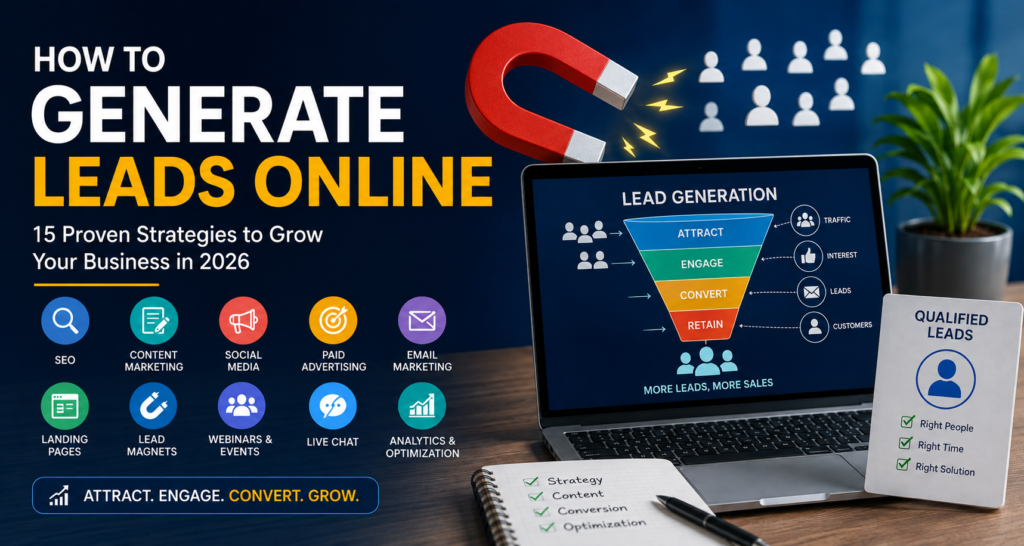
Every business needs a consistent flow of potential customers. Whether you run a local service business, ecommerce store, consulting company, SaaS business, agency, or professional practice, generating qualified leads online can help you build a predictable sales pipeline and grow revenue.
But how to generate leads online effectively in 2026 is very different from simply putting a website online and waiting for visitors.
Modern customers research businesses before contacting them. They search Google, compare websites, read reviews, watch videos, check social media, and look for proof that a company can solve their problem.
This means your online presence needs to do more than attract traffic. It needs to turn attention into interest, interest into enquiries, and enquiries into customers.
The good news is that businesses have more lead-generation opportunities than ever. SEO, content marketing, social media, Google Ads, email marketing, landing pages, online events, referrals, and conversion optimization can all contribute to a successful lead generation strategy.
In this guide, we’ll explore 15 proven online lead generation strategies you can use in 2026, how to generate qualified leads, how to build a high-converting business website, and how to measure whether your lead generation efforts are actually producing business results.
What Is Online Lead Generation?
Online lead generation is the process of attracting potential customers through digital channels and encouraging them to provide their contact information or take a meaningful action.
A lead might:
- Fill out a contact form
- Request a quotation
- Book a consultation
- Subscribe to an email list
- Download an ebook
- Register for a webinar
- Request a product demo
- Start a free trial
- Send a WhatsApp message
- Call your business
- Make an enquiry through social media
The goal isn’t simply to collect as many contacts as possible.
The real objective is to generate qualified leads—people who have a genuine need for your product or service and have the potential to become paying customers.
Why Is Online Lead Generation Important?
Traditional marketing can still work, but digital lead generation offers businesses powerful advantages.
Reach Customers Where They Search
Potential customers increasingly use search engines, social media, online communities, and websites to research solutions.
Target Specific Audiences
Digital platforms allow businesses to target audiences based on interests, locations, demographics, search behavior, and other factors.
Measure Performance
You can track:
- Website visitors
- Leads
- Conversion rates
- Cost per lead
- Sales
- Revenue
- Return on investment
Scale What Works
Once you discover a profitable lead generation channel, you can invest more resources into it.
Build Long-Term Assets
SEO, content, email lists, reviews, and a strong website can continue generating opportunities over time.
How to Generate Leads Online: 15 Proven Strategies
1. Build a High-Converting Business Website
Your website is often the foundation of your digital lead generation system.
Getting traffic is only half the job.
Your website needs to convince visitors to take action.
This is why learning how to build a high-converting business website is essential for any business that wants to generate leads online.
A high-converting website should include:
- A clear value proposition
- Simple navigation
- Strong calls-to-action
- Mobile-friendly design
- Fast page speed
- Trust signals
- Customer testimonials
- Case studies
- Easy-to-find contact information
- Simple lead forms
- Relevant landing pages
Instead of making visitors figure out what to do, guide them toward the next step.
For example:
“Get Your Free Consultation”
is more actionable than:
“Learn More.”
Your website should also answer the most important questions potential customers have:
- What do you offer?
- Who is it for?
- What makes you different?
- Why should customers trust you?
- How much does it cost?
- What happens next?
A well-designed lead generation website can dramatically improve the value of the traffic you’re already receiving.
2. Use SEO to Attract Organic Traffic
SEO lead generation is one of the most powerful long-term strategies for attracting potential customers.
When someone searches Google for a problem your business solves, appearing in relevant organic results can introduce your company at exactly the right moment.
For example, a web development agency might target searches such as:
- Web development services
- Business website design
- Ecommerce website development
- WordPress development services
- How to build a business website
A strong SEO strategy should include:
- Keyword research
- Technical SEO
- On-page optimization
- Content creation
- Internal linking
- Local SEO
- Link building
- Conversion optimization
Don’t focus exclusively on high-volume keywords.
Commercial and long-tail keywords can often attract visitors with stronger purchase intent.
3. Create High-Quality Content
Content marketing for lead generation involves creating useful information that attracts your target audience and moves them toward becoming customers.
Examples include:
- Blog posts
- Tutorials
- Guides
- Case studies
- Videos
- Infographics
- Checklists
- Industry reports
- Comparison articles
- Frequently asked questions
For example, a digital marketing agency could publish:
“How to Create a Digital Marketing Strategy for a Small Business”
At the end of the article, the company could offer a free strategy consultation.
The content attracts the visitor.
The offer generates the lead.
The sales process then converts the lead.
That’s the basic principle behind digital lead generation through content.
4. Create High-Converting Landing Pages
A landing page is designed around a specific marketing objective.
Instead of sending Google Ads traffic to your homepage, create a dedicated page related to the advertisement.
For example:
Google Ad:
“Affordable SEO Services for Small Businesses”
Landing Page:
“SEO Services for Small Businesses”
The landing page should reinforce the promise made in the advertisement.
Include:
- Strong headline
- Clear benefits
- Relevant information
- Social proof
- Testimonials
- Trust signals
- Strong CTA
- Short lead form
Avoid unnecessary navigation and distractions when they aren’t needed.
5. Use Google Ads for Immediate Lead Generation
SEO can take time.
Google Ads lead generation can help businesses reach potential customers who are actively searching for their products or services.
For example, someone searching:
“emergency plumber near me”
may have immediate buying intent.
A targeted search campaign can place your business in front of that person at the right moment.
To improve paid advertising results:
- Target high-intent keywords
- Write relevant ad copy
- Use negative keywords
- Create dedicated landing pages
- Track conversions
- Test different headlines
- Monitor cost per lead
Don’t judge Google Ads based only on clicks.
Measure qualified leads and revenue.
6. Leverage Social Media Marketing
Social media can generate leads through both organic and paid strategies.
Platforms such as Facebook, Instagram, LinkedIn, YouTube, and other networks can help businesses build awareness and relationships.
Effective social media lead generation techniques include:
- Educational posts
- Short-form videos
- Customer stories
- Testimonials
- Live sessions
- Polls
- Lead forms
- Direct messages
- Promotional offers
- Webinars
The key is to avoid making every post a sales pitch.
Provide value first.
Build trust.
Then create opportunities for people to contact your business.
7. Create Lead Magnets
A lead magnet is a valuable resource offered in exchange for contact information.
Examples include:
- Free ebook
- Checklist
- Template
- Free consultation
- Industry report
- Calculator
- Audit
- Toolkit
- Webinar
- Free trial
For example:
“Download Our Free 25-Point Website SEO Checklist.”
A visitor provides their email address to access the resource.
You now have permission to continue the relationship through email marketing.
The best lead magnets solve a specific problem for a specific audience.
8. Use Email Marketing
Email remains an important part of online customer acquisition.
Once someone becomes a lead, you can nurture the relationship through useful and relevant emails.
An email sequence might include:
Email 1: Welcome
Email 2: Helpful educational content
Email 3: Common mistakes
Email 4: Case study
Email 5: Offer or consultation
The objective isn’t to send endless promotional messages.
Instead, provide useful information that helps prospects move closer to a buying decision.
Segment your email list whenever possible so that different audiences receive more relevant messages.
9. Build a Referral Program
Your existing customers can become a valuable source of new leads.
A referral strategy encourages satisfied customers to recommend your business to people they know.
You can offer:
- Discounts
- Credits
- Bonuses
- Special offers
- Referral rewards
However, incentives aren’t always necessary.
Excellent customer service and memorable results can naturally encourage referrals.
Ask satisfied customers whether they know someone who could benefit from your service.
10. Use Local SEO
For businesses serving specific geographic areas, local SEO can be extremely valuable.
Someone searching:
“best digital marketing agency in [city]”
has a very different intent from someone searching:
“what is digital marketing?”
The first person may be much closer to making a purchase.
Important local SEO activities include:
- Google Business Profile optimization
- Local keyword targeting
- Reviews
- Local citations
- Location pages
- Local content
- Relevant local backlinks
For small businesses, local SEO can be one of the most cost-effective lead generation strategies when implemented correctly.
11. Publish Case Studies and Testimonials
People want evidence before buying.
A business can say:
“We deliver excellent results.”
But a case study can demonstrate exactly how those results were achieved.
A strong case study can explain:
Problem → Strategy → Implementation → Result
For example:
A company struggled to generate qualified enquiries from organic search. After restructuring its website, improving SEO, and optimizing landing pages, qualified organic leads increased significantly.
Whenever possible, include measurable results.
Testimonials can also strengthen trust.
Place relevant testimonials near calls-to-action so visitors see social proof when making decisions.
12. Use Webinars and Online Events
Webinars can be powerful for B2B and professional-service businesses.
Choose a topic that solves a specific problem.
For example:
“How to Generate 50 Qualified Leads From Your Business Website.”
Promote the webinar through:
- SEO
- Social media
- Paid advertising
- Partnerships
Registration becomes the lead-generation mechanism.
During the webinar, provide valuable information rather than turning the entire session into a sales presentation.
At the end, offer a logical next step.
13. Add Live Chat and Conversational Marketing
Some visitors don’t want to complete a long contact form.
They may have a simple question before deciding whether to contact you.
Live chat, messaging integrations, and conversational tools can reduce this friction.
Examples include:
“Have a question? Chat with us.”
or:
“Need help choosing the right service?”
Keep conversations focused and make it easy for visitors to move from questions to action.
14. Retarget Website Visitors
Many visitors won’t become leads during their first visit.
They may:
- Compare competitors
- Research prices
- Discuss the purchase with someone
- Need approval
- Simply not be ready
Retargeting can help bring previous visitors back to your business.
Depending on the platform and applicable privacy requirements, businesses can use advertising campaigns to reconnect with audiences who previously interacted with their website or content.
Retargeting messages can promote:
- Free consultations
- Special offers
- Case studies
- Product benefits
- Webinars
- Demonstrations
The goal is to remain relevant without overwhelming the audience.
15. Track and Optimize Your Lead Generation Funnel
The final strategy is perhaps the most important.
You need to know what’s working.
Your lead generation funnel might look like:
Search/Social/Ads → Website → Landing Page → Lead Form → Follow-Up → Sales → Customer
Track each stage.
Important metrics include:
- Website traffic
- Conversion rate
- Number of leads
- Qualified leads
- Cost per lead
- Lead-to-customer rate
- Customer acquisition cost
- Revenue
- Return on investment
Suppose you receive 5,000 visitors and generate 100 leads.
Your website conversion rate is:
100 ÷ 5,000 × 100 = 2%
If you improve the conversion rate to 4%, the same traffic could generate 200 leads.
That’s why improving your website can sometimes be more valuable than simply buying more traffic.
How to Generate Qualified Leads Online
Generating thousands of leads isn’t necessarily a success.
If most leads aren’t interested in your product, your sales team wastes time.
To generate better-quality leads:
Define Your Ideal Customer
Understand:
- Industry
- Location
- Budget
- Needs
- Problems
- Buying behavior
Use Intent-Based Keywords
Target searches that indicate a genuine need.
Create Relevant Landing Pages
Match the page to the visitor’s intent.
Qualify Leads
Ask appropriate questions on forms.
For example:
- Company size
- Budget range
- Service required
- Project timeline
Create Targeted Content
Different customer segments need different information.
Quality should always matter more than raw lead volume.
How to Build a High-Converting Lead Generation Website
If your website is at the center of your marketing strategy, learning how to build a high-converting business website should be a priority.
A high-converting website typically combines five elements:
1. Clear Positioning
Explain what your company does and who it helps.
2. Strong Value Proposition
Tell visitors why they should choose you.
3. Trust
Use:
- Reviews
- Testimonials
- Case studies
- Credentials
- Client logos
- Guarantees where appropriate
4. Strong Calls-to-Action
Make the next step obvious.
5. Low Friction
Don’t ask visitors for unnecessary information.
A five-field form may sometimes outperform a 12-field form simply because it requires less effort.
Your website should also be:
- Fast
- Secure
- Mobile-friendly
- Accessible
- SEO-friendly
- Easy to navigate
Best Lead Generation Channels for Small Businesses
Not every business needs to use every marketing channel.
A small business can start by focusing on two or three channels that align with its audience.
Local Service Business
Consider:
- Local SEO
- Google Ads
- Reviews
- Referral marketing
B2B Business
Consider:
- SEO
- Content marketing
- Email marketing
- Webinars
Ecommerce Business
Consider:
- SEO
- Google Ads
- Social media
- Email marketing
- Retargeting
Professional Services
Consider:
- SEO
- Content marketing
- Case studies
- Webinars
- Referral marketing
The best strategy depends on where your ideal customers spend time and how they make buying decisions.
SEO vs Paid Advertising for Lead Generation
Both SEO and paid advertising can generate leads, but they work differently.
SEO
Advantages:
- Long-term organic visibility
- Compounding content value
- No direct cost per organic click
- Builds authority
Challenges:
- Takes time
- Requires ongoing optimization
- Competitive keywords can be difficult
Paid Advertising
Advantages:
- Faster visibility
- Precise targeting
- Scalable campaigns
- Immediate testing opportunities
Challenges:
- Requires ongoing advertising spend
- Competition affects click costs
- Poor campaigns can waste budget
For many businesses, the strongest approach is not SEO or paid advertising.
It’s using both strategically.
How to Create a Lead Generation Funnel
A basic online lead generation funnel can contain four stages.
Stage 1: Awareness
People discover your business through:
- Social media
- YouTube
- Ads
- Content
- Referrals
Stage 2: Interest
They visit your website or landing page.
Your content should answer their questions and demonstrate your expertise.
Stage 3: Conversion
The visitor becomes a lead by:
- Calling
- Filling out a form
- Booking an appointment
- Downloading a resource
- Requesting a quote
Stage 4: Nurturing and Sales
Your business follows up and helps the prospect make a purchasing decision.
The funnel shouldn’t stop at the lead.
Your sales and follow-up process are equally important.
Common Online Lead Generation Mistakes
Avoid these common mistakes:
Focusing Only on Traffic
Traffic isn’t the same as leads.
Having Weak Calls-to-Action
Visitors need clear next steps.
Sending All Traffic to the Homepage
Create dedicated landing pages for important campaigns.
Ignoring Mobile Users
Many prospects will discover your business through smartphones.
Buying Low-Quality Leads
Cheap leads can waste valuable sales time.
Not Following Up Quickly
A strong lead can lose interest if nobody responds.
Not Tracking Conversions
If you don’t measure results, you won’t know what’s working.
Using Too Many Marketing Channels
Start focused rather than spreading your resources too thin.
How to Measure Online Lead Generation Success
The most important metrics depend on your business model.
However, these are useful starting points:
Lead Conversion Rate
Leads ÷ Website Visitors × 100
Cost Per Lead
Marketing Spend ÷ Number of Leads
Lead-to-Customer Rate
Customers ÷ Leads × 100
Customer Acquisition Cost
Total Sales and Marketing Costs ÷ New Customers
Return on Investment
Revenue Generated − Marketing Cost ÷ Marketing Cost
Don’t judge campaigns using a single metric.
A campaign with a higher cost per lead may still be better if those leads generate significantly more revenue.
Online Lead Generation Checklist for 2026
Use this checklist to evaluate your strategy:
- Define your ideal customer
- Build a conversion-focused website
- Research high-intent keywords
- Optimize your website for SEO
- Create useful content
- Build dedicated landing pages
- Add clear calls-to-action
- Create a lead magnet
- Build an email list
- Use social media strategically
- Consider Google Ads
- Optimize local SEO if relevant
- Collect genuine testimonials
- Publish case studies
- Use retargeting where appropriate
- Track conversions
- Follow up with leads
- Measure revenue, not just traffic
Final Thoughts: How to Generate Leads Online Successfully
Learning how to generate leads online isn’t about discovering one magic marketing channel.
Successful lead generation usually comes from building a connected system.
Your SEO attracts people searching for solutions.
Your content educates them.
Your social media builds awareness and trust.
Your advertising captures high-intent opportunities.
Your landing pages turn visitors into prospects.
Your email marketing nurtures relationships.
And your website converts those prospects into leads and customers.
Most importantly, your website needs to support the entire process.
That’s why understanding how to build a high-converting business website is one of the most valuable skills for any business investing in digital marketing.
Think of your online lead generation system as:
Traffic → Engagement → Trust → Conversion → Follow-Up → Sale → Customer
If one part of the system is weak, your overall results can suffer.
Instead of chasing more traffic immediately, start by asking:
Are we attracting the right people?
Are we giving them a compelling reason to contact us?
Is our website making conversion easy?
Are we following up effectively?
Are we measuring the revenue generated by each channel?
Answering these questions will help you build a more sustainable business lead generation strategy.
In 2026, businesses that combine SEO, content, paid advertising, social media, email marketing, conversion optimization, and a high-quality website will be in a much stronger position to attract and convert customers online.
The goal isn’t simply to generate more leads.
The goal is to generate more of the right leads—and turn them into profitable customers.
Leave a Reply