How to Build a High-Converting Business Website That Turns Visitors Into Customers
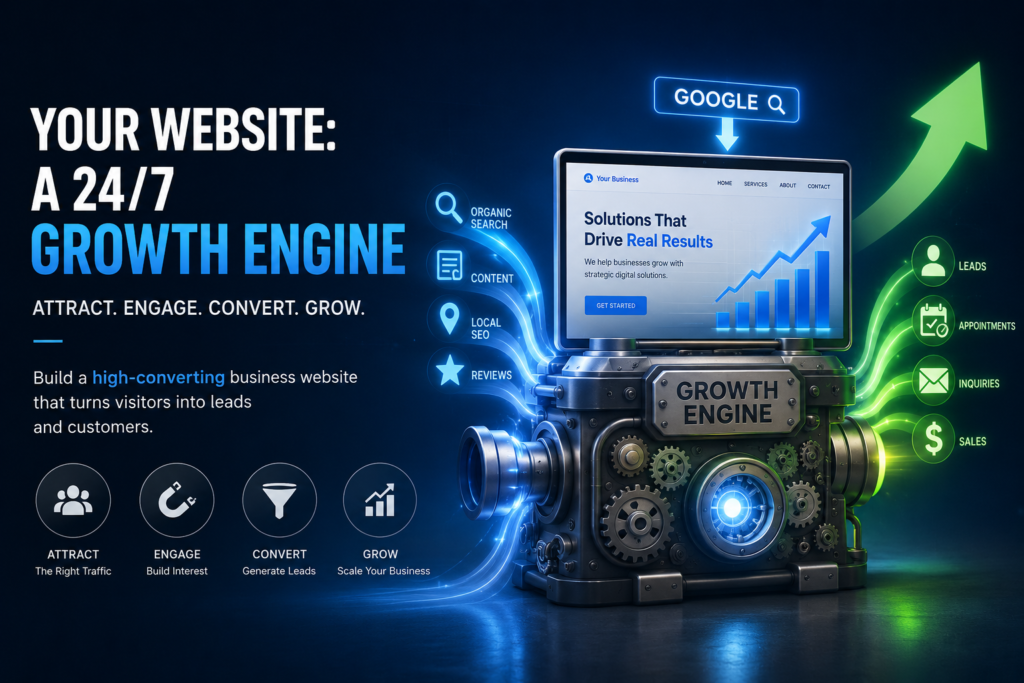
A business website should do much more than tell people who you are and what you sell. In today’s digital marketplace, your website can be your most important salesperson—working 24/7 to attract potential customers, answer their questions, build trust, generate leads, and drive sales.
But simply having a website isn’t enough.
You can have a beautiful design, impressive animations, professional images, and hundreds of pages of content and still struggle to generate customers.
The real question is:
Does your website turn visitors into leads and customers?
Learning how to build a high-converting business website requires a combination of strategic design, compelling content, search engine optimization (SEO), user experience, trust-building elements, strong calls to action, and continuous testing.
In this guide, we’ll explain how to create a high-converting business website that doesn’t just attract visitors but encourages them to take meaningful action.
What Is a High-Converting Business Website?
A high-converting business website is designed around a specific business goal.
That goal might be:
- Generating leads
- Getting phone calls
- Booking appointments
- Selling products
- Getting quote requests
- Increasing subscriptions
- Scheduling consultations
- Encouraging visitors to download resources
A traditional website may simply provide information.
A conversion-focused website guides visitors toward the next step.
For example, instead of ending a service page with nothing more than a paragraph of text, a high-converting website might provide a clear CTA such as:
“Get Your Free Website Audit”
or
“Book a Free Strategy Call.”
The objective is to remove confusion and make it easy for visitors to take action.
Website Design vs. Website Conversion
Good website design is important, but design alone doesn’t guarantee results.
A website can look fantastic and still have a poor website conversion rate.
A high-converting website combines:
Design + Content + UX + SEO + Trust + CTA + Analytics + Optimization
The result is a website designed not just to look professional but to generate measurable business outcomes.
Why Your Business Website Needs to Focus on Conversions
Your website is often one of the first places potential customers interact with your business.
Before contacting you, customers may:
- Search for your business on Google
- Visit your website
- Read your services
- Compare competitors
- Look at testimonials
- Review case studies
- Check your pricing
- Evaluate your credibility
If your website fails to communicate your value quickly, visitors may leave and choose a competitor.
A conversion-focused website helps answer three critical questions:
1. What do you offer?
Visitors should immediately understand your product or service.
2. Why should they choose you?
Your website should communicate your experience, expertise, results, benefits, and differentiators.
3. What should they do next?
Your CTA should tell visitors exactly what action to take.
A strong business website makes these answers obvious.
15 Essential Elements of a High-Converting Business Website
If you’re wondering how to build a high-converting business website, start with these essential elements.
1. Start With a Clear Value Proposition
Your value proposition explains why customers should choose your business.
It should communicate:
- What you do
- Who you help
- What problem you solve
- What makes your solution valuable
For example, instead of:
“Welcome to ABC Digital Agency.”
A stronger headline might be:
“We Help Small Businesses Generate More Leads Through High-Converting Websites and Digital Marketing.”
The second version immediately communicates the business outcome.
2. Create a Strong, Benefit-Focused Headline
Your homepage headline is one of the most important elements of your website.
Visitors should understand your primary offer within a few seconds.
Avoid vague headlines such as:
“Innovative Solutions for a Better Future.”
Instead, focus on a specific customer benefit:
“Build a Website That Attracts More Customers and Generates More Leads.”
A strong headline should be:
- Clear
- Specific
- Relevant
- Benefit-oriented
- Easy to understand
Your visitors shouldn’t have to figure out what your company does.
3. Use Clear Calls to Action
A call to action tells visitors what to do next.
Examples include:
- Get a Free Quote
- Book a Consultation
- Request a Demo
- Start Your Free Trial
- Get a Free Website Audit
- Shop Now
- Schedule an Appointment
- Download the Guide
Avoid generic CTAs such as:
“Click Here.”
Instead, communicate the benefit:
“Get My Free Website Audit.”
A high-converting website should have strategically placed CTAs throughout the customer journey.
4. Design for Your Target Audience
One of the biggest mistakes businesses make is designing their website for themselves instead of their customers.
Before starting your business website design, identify:
- Who is your ideal customer?
- What problems do they have?
- What are they searching for?
- What objections might they have?
- What motivates them to buy?
- What information do they need before making a decision?
Your website messaging, imagery, navigation, content, and CTA should reflect your audience.
A website for a law firm should look and communicate differently from a website for a fashion ecommerce company.
5. Build Trust With Social Proof
People are more likely to trust a business when they see evidence that others have had positive experiences.
Include social proof such as:
- Customer reviews
- Testimonials
- Client logos
- Case studies
- Industry certifications
- Awards
- Ratings
- Results
- Media mentions
For example:
“Helped 500+ businesses increase their online visibility.”
is more persuasive than simply saying:
“We’re experts in digital marketing.”
Whenever possible, use specific and verifiable results.
6. Showcase Customer Testimonials
Testimonials help reduce uncertainty.
A good testimonial should ideally explain:
Problem → Solution → Result
For example:
“Our old website wasn’t generating enough leads. After the redesign and conversion optimization, we started receiving significantly more qualified inquiries.”
Even better, include:
- Customer name
- Company
- Photo, when permitted
- Industry
- Specific result
Authentic testimonials are particularly valuable on service-business websites.
7. Create Simple and Intuitive Navigation
Your website navigation should help visitors find what they need without making them think.
A simple structure might include:
Home | Services | Industries | Case Studies | About | Resources | Contact
Avoid overwhelming visitors with dozens of menu items.
Your most important pages should be easy to access.
A visitor should be able to answer:
“Where am I?”
“What can I do here?”
“How do I contact this company?”
within seconds.
8. Optimize Your Website for Mobile Devices
A large percentage of website traffic comes from smartphones.
That’s why mobile optimization should be part of your website strategy from the beginning—not something you add later.
Check:
- Font size
- Button size
- Navigation
- Forms
- Images
- Page spacing
- Checkout process
- Loading speed
- Mobile pop-ups
Your website should be easy to use with one hand on a smartphone.
A beautiful desktop website that is difficult to use on mobile can lose potential customers.
9. Improve Website Loading Speed
Slow websites create a poor user experience.
Visitors may leave before your content even loads.
Improve performance by:
- Compressing images
- Using modern image formats
- Reducing unnecessary scripts
- Optimizing CSS and JavaScript
- Using caching
- Choosing reliable hosting
- Minimizing unnecessary plugins
- Using a content delivery network where appropriate
Website speed also contributes to a better overall user experience and can support your SEO efforts.
10. Create High-Converting Landing Pages
Don’t send every visitor to your homepage.
Different campaigns and audiences often need different landing pages.
For example:
Google Ads → Google Ads Landing Page
Facebook Campaign → Facebook Landing Page
Real Estate Campaign → Real Estate Lead Page
Free SEO Audit → SEO Audit Landing Page
A landing page should have one primary goal.
Remove unnecessary distractions and focus on:
Problem → Solution → Benefits → Proof → CTA
This approach can significantly improve website lead generation.
11. Use High-Quality Visuals
Visual content can influence how visitors perceive your business.
Use images and graphics that support your message rather than simply filling empty space.
Depending on your business, you might use:
- Product photography
- Team photographs
- Before-and-after images
- Infographics
- Screenshots
- Videos
- Process diagrams
- Case-study visuals
Avoid excessive stock photography that makes your business look generic.
Authentic visuals can help build credibility.
12. Make Your Contact Process Simple
If someone wants to contact you, don’t make them search for your phone number or complete a 15-field form.
Keep forms simple.
Ask only for information you actually need.
For example:
- Name
- Phone
- Business
- How can we help?
You can collect additional information later.
For high-ticket services, a longer qualification form may be appropriate, but it should still feel simple and purposeful.
13. Optimize Forms for Lead Generation
Your contact form is an important part of your lead generation website.
Experiment with:
- Form length
- CTA text
- Page placement
- Number of fields
- Trust statements
- Privacy messaging
- Multi-step forms
Instead of:
Submit
try:
Get My Free Consultation
or:
Request My Free Quote
The CTA should communicate what happens after the visitor clicks.
14. Use SEO to Attract the Right Visitors
A beautiful website won’t generate results if nobody can find it.
Search engine optimization helps your business attract people actively searching for your products or services.
Your SEO strategy should include:
- Keyword research
- Search intent
- On-page SEO
- Technical SEO
- Internal linking
- High-quality content
- Local SEO where relevant
- Image optimization
- Page speed
- Mobile optimization
- Structured data where appropriate
But don’t optimize only for search engines.
Optimize for people who are likely to become customers.
There is little value in generating thousands of irrelevant visitors who never buy anything.
15. Track, Test, and Improve Your Website
Launching your website isn’t the end of the process.
It’s the beginning.
Use analytics and conversion tracking to understand:
- Where visitors come from
- Which pages they visit
- Where they leave
- Which CTAs they click
- Which forms they complete
- Which traffic sources generate leads
- Which pages generate sales
Then test improvements.
For example:
Headline A vs. Headline B
CTA A vs. CTA B
Short form vs. long form
Video vs. static image
Long landing page vs. short landing page
This ongoing process is known as website conversion optimization.
How to Structure a High-Converting Business Homepage
Your homepage should guide visitors through a logical journey.
A proven structure is:
1. Hero Section
Clearly explain what you do and include your primary CTA.
2. Problem
Show visitors that you understand their challenges.
3. Solution
Explain how your product or service solves the problem.
4. Benefits
Focus on outcomes rather than just features.
5. Services or Products
Show visitors what you offer.
6. Social Proof
Add testimonials, reviews, client logos, and results.
7. Case Studies
Demonstrate how you’ve helped real customers.
8. Process
Explain what working with you looks like.
9. FAQ
Answer common objections.
10. Final CTA
Give visitors one clear next step.
This structure helps transform your homepage from an online brochure into a website that converts.
How SEO and Conversion Optimization Work Together
SEO and conversion optimization are closely connected, but they have different jobs.
Think about it this way:
SEO brings qualified visitors.
Conversion optimization turns visitors into leads.
Sales processes turn leads into customers.
For example, imagine your website receives 10,000 visitors every month.
At a 2% conversion rate:
10,000 × 2% = 200 leads
If optimization increases the conversion rate to 5%:
10,000 × 5% = 500 leads
You generated an additional 300 leads without necessarily increasing your website traffic.
That’s why getting more traffic isn’t always the answer.
Sometimes the bigger opportunity is to convert more of the traffic you already have.
Common Business Website Mistakes That Reduce Conversions
Even experienced businesses make website mistakes.
Here are some of the most common:
Unclear Messaging
Visitors don’t understand what you offer.
Too Many CTAs
Giving visitors too many choices can create confusion.
Poor Mobile Experience
Your website works well on desktop but poorly on smartphones.
Slow Loading Speed
Visitors leave before your page loads.
No Social Proof
You claim you’re good but don’t show evidence.
Complicated Forms
Visitors don’t want to spend five minutes filling out a form.
Weak Headlines
Your headline focuses on your company instead of the customer’s problem.
Feature-Focused Content
You describe what your product does instead of explaining how it benefits the customer.
Sending All Traffic to the Homepage
Different audiences and campaigns often require dedicated landing pages.
Not Tracking Conversions
Without measurement, you don’t know what’s working.
How to Measure Your Website Conversion Rate
Your website conversion rate measures the percentage of visitors who complete a desired action.
A basic formula is:
Conversion Rate = Conversions ÷ Visitors × 100
For example:
If 1,000 people visit your website and 40 submit a contact form:
40 ÷ 1,000 × 100 = 4%
However, there isn’t one universal “good” conversion rate for every website.
Conversion rates vary depending on:
- Industry
- Traffic source
- Product
- Price
- Audience
- Offer
- Location
- Device
- Buying intent
- Website experience
Instead of chasing an arbitrary benchmark, focus on establishing your current performance and continuously improving it.
Tools You Can Use to Improve Website Conversions
Several tools can help you understand and improve your website.
Google Analytics
Use analytics to understand traffic, user behavior, conversions, and acquisition sources.
Google Search Console
Monitor search performance, indexing, queries, and technical SEO issues.
PageSpeed Insights
Evaluate website performance and identify opportunities to improve loading speed.
Microsoft Clarity
Use session recordings and heatmaps to understand how visitors interact with your pages.
CRM and Marketing Automation
Connect website leads to your CRM and automate follow-ups.
The goal isn’t to collect data for the sake of data.
The goal is to use data to make better decisions.
How to Build a High-Converting Website Step by Step
If you’re starting from scratch, follow this process.
Step 1: Define Your Target Audience
Identify exactly who you want to attract.
Step 2: Identify Their Problems
Understand their pain points, goals, objections, and buying behavior.
Step 3: Define Your Offer
Explain exactly what you’re offering and why it’s valuable.
Step 4: Plan Your Website Structure
Create your sitemap and determine the purpose of every important page.
Step 5: Write Conversion-Focused Content
Focus on customer problems, benefits, proof, and outcomes.
Step 6: Design the Website
Create a clean, professional and user-friendly interface.
Step 7: Add Trust Elements
Use testimonials, reviews, case studies, certifications, guarantees where appropriate, and other evidence.
Step 8: Optimize for SEO
Build pages around relevant search terms and user intent.
Step 9: Optimize Mobile and Speed
Make sure your website performs well across devices.
Step 10: Add Analytics and Conversion Tracking
Track leads, calls, purchases, bookings, and other important actions.
Step 11: Launch
Test everything before making the website publicly available.
Step 12: Test and Improve
Use real visitor data to continually improve your website.
High-Converting Business Website Checklist
Before launching your website, ask:
- Is the value proposition immediately clear?
- Does the homepage explain what the business does?
- Is the target audience clearly defined?
- Does every important page have a clear CTA?
- Is the website mobile-friendly?
- Does it load quickly?
- Is navigation simple?
- Are testimonials visible?
- Are case studies available?
- Is the website optimized for search engines?
- Are contact forms easy to complete?
- Are landing pages optimized for campaigns?
- Is conversion tracking installed?
- Are important calls and form submissions tracked?
- Do visitors have a clear next step?
- Are you testing and improving the website regularly?
If you can answer “yes” to most of these questions, you’re moving in the right direction.
Conclusion: Your Website Should Be a Growth Engine
A high-converting business website isn’t simply a beautiful collection of web pages.
It’s a business growth system.
It should attract the right audience, communicate your value, build trust, answer objections, and make it easy for visitors to take action.
The complete process looks like this:
Attract → Engage → Build Trust → Convert → Follow Up → Sell → Improve
If your website receives traffic but isn’t generating enough leads or sales, the solution may not be to simply spend more money on advertising.
You may need to improve the website itself.
Review your messaging. Simplify your navigation. Strengthen your offer. Improve your CTAs. Add social proof. Optimize your landing pages. Make your website faster and easier to use. Then measure the results and keep improving.
Your website should work for your business 24/7.
If you’re ready to turn your website into a stronger lead-generation and conversion engine, SigmaTechs can help you build, optimize, and grow a conversion-focused digital presence—from website development and SEO to landing pages, funnels, digital marketing, and AI-powered automation.
Ready to find out how well your website is converting? Get a free website growth audit from SigmaTechs and discover the opportunities you’re missing.
Leave a Reply